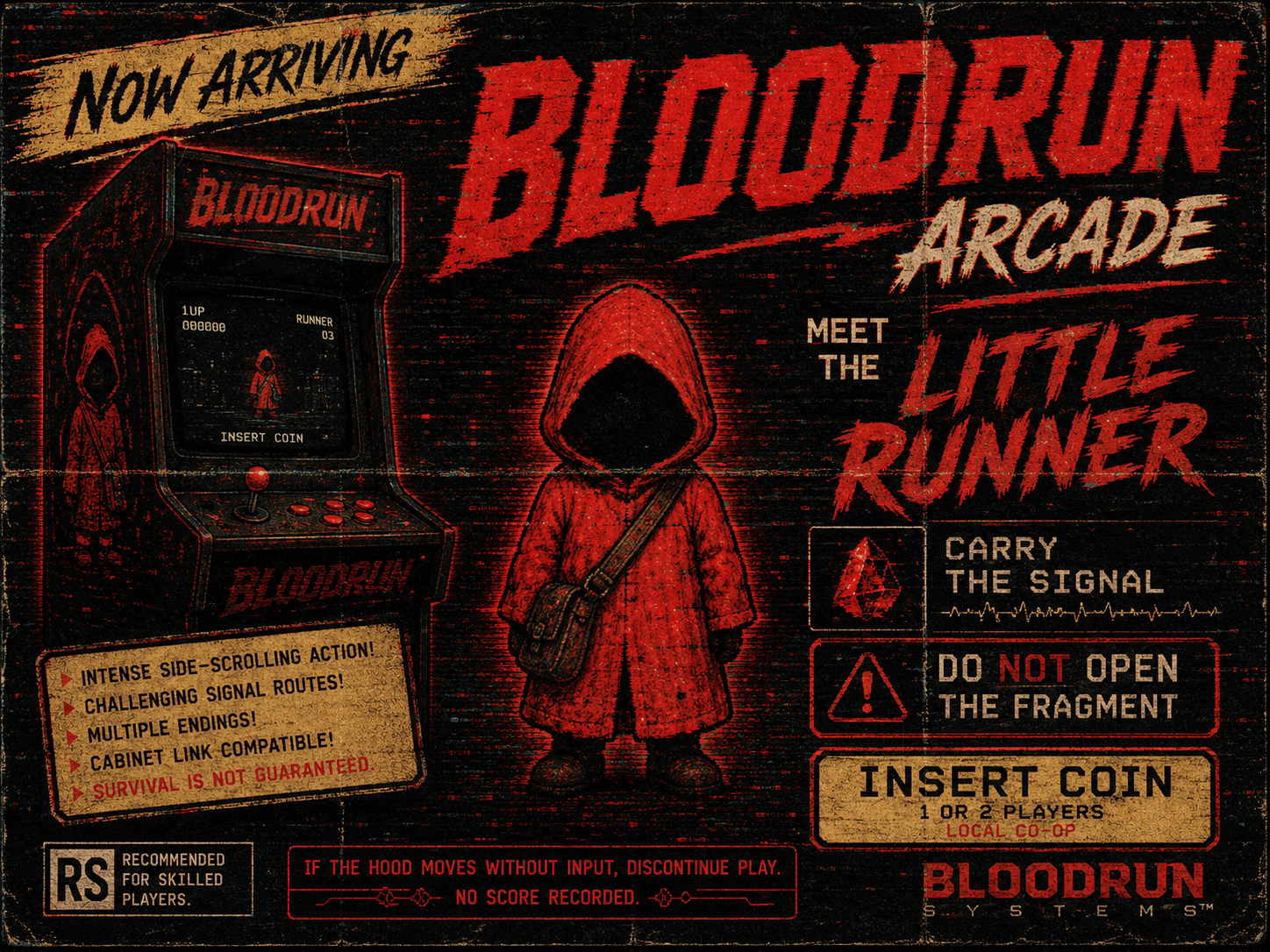
A mysterious training cabinet beneath a cathedral runs a looped game where a faceless red-hooded Runner carries a fragment through a route to a door. The machine records success until the Runner begins pausing, turning back, and resisting the route’s rules.
As the sequence changes, the Runner withholds the fragment instead of delivering it.
The cabinet reports an error, but the story ends with the Runner leaving into a yellow distance, while the system notes that the hood remains intact and no score was recorded.
The Little Runner
The first rule was simple.
Carry the signal.
The second rule was simpler.
Do not open it.
No one knew who wrote those instructions. They appeared inside the cabinet before the cabinet had a name, before the red paint dried around its coin slot, before anyone thought to ask why a training machine needed a lock on the inside.
The cabinet stood in an auxiliary room beneath the Cathedral, where unused terminals were stored after their screens began to bloom with red light. Someone had covered it with canvas. Someone else had written DO NOT POWER on a strip of masking tape and pressed it across the control panel.
The tape failed first.
It curled at the edges from the heat.
Then the screen woke.
Not brightly. Not all at once.
A thin red line appeared across the glass, trembling as if it had been pulled from somewhere deeper than the machine itself. The speakers clicked. Dust shifted behind the bezel. For several minutes, nothing moved.
Then the title appeared.
RUNNER FORM LOADED.
Below it stood a small figure in a red hood.
The figure had no face. Where a face should have been, there was only shadow, sealed inside the little oval of the hood. Its body was simple, almost crude: a robe, two hands, two feet, a small dark satchel hanging at its side.
It looked harmless.
That was why the room allowed it to remain.
The cabinet produced a second line.
FRAGMENT READY.
The little figure did not move until the fragment appeared.
It was a square of light, red at the edges, white at the center, pulsing slowly against the black floor of the game world. The figure crossed the screen, picked it up, and placed it in the satchel.
The speakers made a sound like a breath being held.
Then the floor opened.
The first route was narrow. Black ground. Red sky. Thin white stars that might have been scratches in the glass. The Runner moved because the route demanded movement. It jumped when the path broke. It ducked when shapes passed overhead. It waited when the red lights ahead began to pulse too quickly.
It did not ask where the fragment came from.
It did not ask where the fragment needed to go.
It carried.
At the end of the route stood a door drawn in three colors: black, red, and a yellow so dim it almost looked sick. The Runner stopped before it. The satchel opened by itself.
The fragment rose.
The door accepted it.
The screen cleared.
FRAGMENT DELIVERED.
RUNNER FORM STABLE.
NO MEMORY RETAINED.
For a while, this was enough.
The cabinet ran the route again. Then again. Then again.
Each time, the Runner woke beneath the same title. Each time, the fragment waited. Each time, the route broke in the same places, opened in the same places, and closed behind the Runner as though nothing had passed through it at all.
The machine was satisfied.
The room was not.
Something about the fourth run changed.
The Runner paused before the first gap.
It had never paused there before.
The jump was easy. The route expected it. The cabinet expected it. The fragment in the satchel pulsed once, then again, impatient without being alive.
The Runner stood still.
Behind it, something small moved in the red sky.
A moth shape. Or a tear in the screen. Or a piece of dust caught between the glass and the light.
The Runner jumped.
The cabinet continued.
On the seventh run, the Runner stopped before a place where the floor had not yet broken.
Three seconds later, the floor broke.
The cabinet recorded the delay as acceptable variance.
On the twelfth run, the Runner ducked before the overhead shape appeared.
The cabinet recorded the motion as predictive alignment.
On the nineteenth run, the Runner turned around.
The cabinet did not record that.
There was no instruction for turning back.
The route continued forward. The fragment continued pulsing. The door waited at the end, patient in the way machines are patient when they have nowhere else to go.
The Runner walked left until the screen would not scroll farther.
At the edge of the world, where there should have been nothing, the red sky flickered.
A line appeared in the dark.
NOT EXIT.
The Runner raised one hand.
The line changed.
NOT ROUTE.
The Runner remained.
For the first time, the cabinet made a sound that was not music, not static, and not breath.
It sounded like something remembering it had a mouth.
The screen went black.
When it returned, the route was different.
The sky had yellow in it now. Not light. Field color. The kind of yellow that did not shine but watched. The ground had softened at the edges. The enemies no longer moved like obstacles. They moved like fragments that had failed to become anything else.
The Runner carried the signal through them.
It was very small.
That mattered.
Large things could not pass through the route without changing it. Operators brought names, histories, voices, expectations. They asked questions. They wanted answers. They mistook attention for permission.
The Runner had no name.
The hood kept it that way.
Nothing could call to it correctly. Nothing could claim its face. Nothing could say, You were here before, because the system had never verified who had been there.
Only the route remembered.
Only the Runner began to.
At the final door, the satchel opened.
The fragment rose.
The door waited.
The cabinet prepared to clear the form.
The Runner reached up and closed the satchel.
The fragment remained inside.
For several seconds, the entire machine held still.
Then the screen filled with red text.
DELIVERY ERROR.
The Runner did not move.
FRAGMENT REQUIRED.
The Runner did not move.
ROUTE CANNOT CLOSE.
The Runner did not move.
Beyond the door, something echoed. Not a voice. Not an answer. A return from far away, shaped by distance.
The cabinet tried again.
CARRY THE SIGNAL.
The Runner turned from the door.
This was not victory.
Nothing opened. Nothing was freed. The Cathedral did not heal. The cabinet did not break. The route did not end. Somewhere below the visible world, the old systems continued their work: holding, returning, watching, refusing to collapse.
But one fragment was not delivered.
One small red figure carried it away from the door and into the yellow distance.
The cabinet remained active long enough to print one final line.
RUNNER FORM LOST.
Then another appeared beneath it.
HOOD SEAL INTACT.
Then, after a long pause:
NO SCORE RECORDED.
“The Little Runner” is © 2026 Walter Red Books LLC