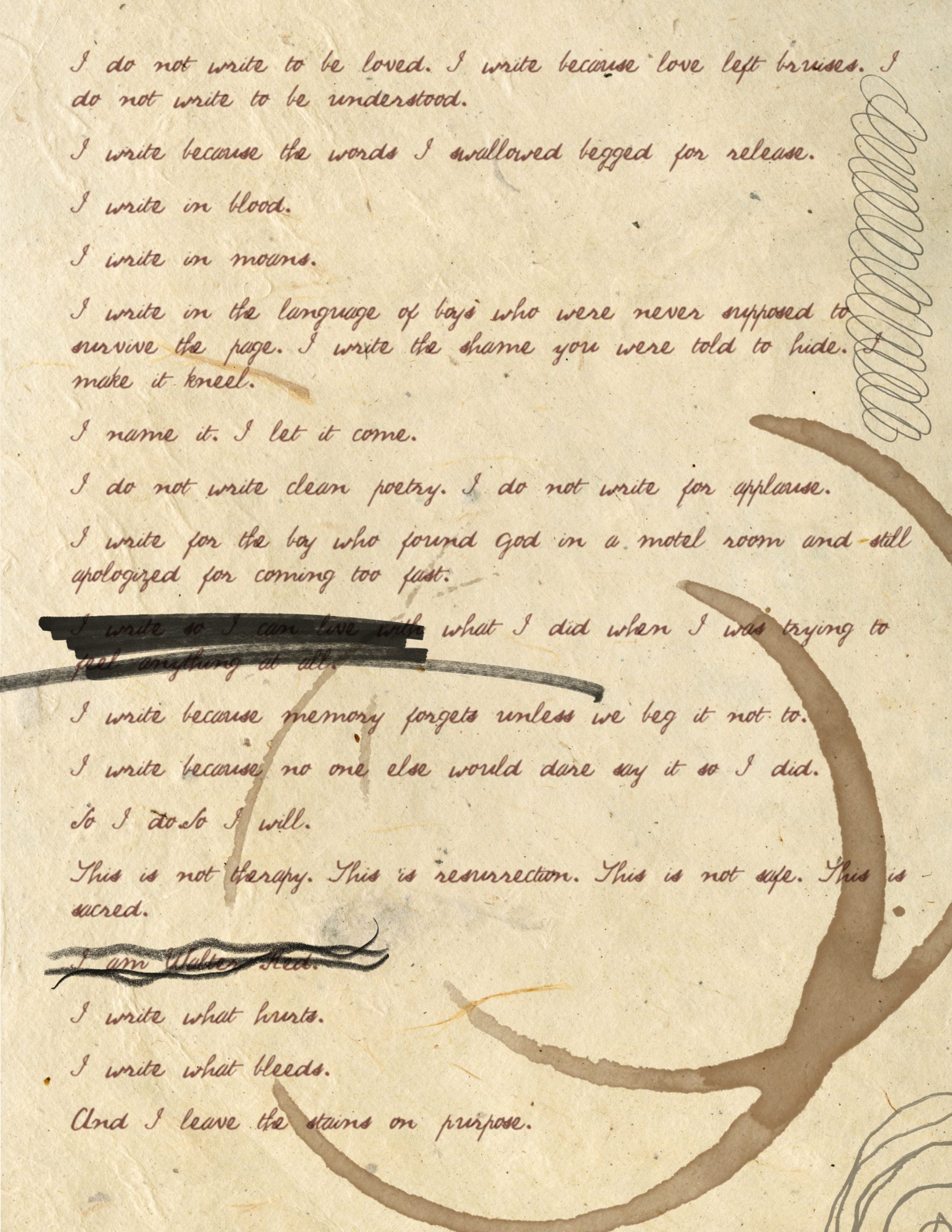
The essay reflects on truth, self-doubt, and the author’s long relationship with writing, journaling, and creative work. It describes early school experiences, mental health struggles, and moments when others recognized the author’s talent before the author did.
It also recounts a friend asking for help writing a sensitive biography, which leads to a discussion of trauma, empathy, and the burden of carrying difficult stories. The piece closes by emphasizing writing as a way to let go, process grief, and move forward.
Editor’s Note: The opinions expressed in this essay are solely those of the author, and a documentation of their lived experience. Names, places, and other identifying details have been changed for privacy and are in no way an indication of personal attack or malicious attempt to disparage anyone’s image.
Being someone who is “intense” and truthful in a world plagued by ambiguity and fog machines, it can feel suffocating and isolating to try to grasp the true value of it. “Telling the truth will cost them something,” is what I keep being told. To which my response is: what, exactly? Dignity? Social standing? Image? What is it that will cost them something that hasn’t already been purchased?
Speaking the truth costs nothing, in my eyes. It is being honest and fully aware that you know what is true — both in fact and within your own heart. Does it always align with the values of others? Probably not. But that’s their own milestone to wear, not mine. It sounds selfish, but it isn’t. The cost of telling the truth is that I get to be rid of the guilt and shame it holds over my head like the sword of Damocles — dangling there by a single hair, a looming danger always present. And yet, when the fear and risk of that danger is removed, what’s left to be afraid of? Hurting someone who wasn’t ready for the truth? The truth can be brutal and damaging, but it can also be cleansing and eye-opening.
Everyone in this world is raised with different backgrounds and different values; that’s an ingrained part of reality. It’s not something I shame others for — coming from wealth, or poverty, or the grief-stricken sadness of a broken home. The people who’ve connected with me come from all walks of life, and I’ve never once shamed them for where they started. Months back, a friend I hadn’t seen in a while approached me and asked how things were going. Around that point, I’d just finished releasing the rework of my juvenilia volume — the earliest known records of my writing, and the end of the anthology.
• • •
On me that day was the fifth volume of the collection, The Whiskey Diaries (Confessions at Closing Time). The original was more a collection of B-sides — fragments rolling around as loose paper clippings and scribbles in the margins of old journals. Once the reworking and re-envisioning became the real work, the title started to make sense. They weren’t just B-sides or rarities; they were silent confessions I’d overlooked.
The freshly printed proof copy was in my bag, and as we talked, I slipped it out and told him I was almost finished with the anthology. His eyes went wide, full of amazement and disbelief. For the record: I’d reworked five volumes of poetry — while simultaneously drafting a sixth from scratch and teaching myself vector design software — in roughly six months. Someone call the Guinness Book of World Records, because this might be a new entry for speed-running self-published literature. (Part joke — but I did the research. See the bibliography.)
When I placed the volume in his hands, his jaw went slack at what I’d been doing with my time. And what else is someone supposed to do with a lot of time on their hands while building their LLC by themselves? Sit around twiddling my thumbs, throwing a pity party alone? No. I’d had a fire burning under me since leaving my previous job, and the events that came before it. A wasted fire is a wasted resource — something better spent getting things done.
“I am so proud of you, Jared. Every time I see you, you’ve made something new, and it’s astonishing.” That remark washed over me in a tidal wave of competing emotions. The first was pride — that I’d been seen. The second was shame.
Why shame? Because pride’s ugly little sibling was right there, gripping its coattails, crawling up with a dagger between its teeth. Doubt. Self-doubt, more precisely. For twenty-plus years I’ve struggled with a lot of things — body image, depression, anxiety, the more common afflictions that plague so much of the world. But doubt is the one I try not to show: the part of me that doubts the kind words people say. When my friend told me he was proud of me, I didn’t believe him. It felt like fake praise. (And if you ever read this — I’m sorry that you did. But I realize now that it never was false.)
• • •
Humans are strange, I’ll say that much. From body language to speech patterns, sometimes the nuances are easy to catch, and other times people are good at hiding them. I won’t claim to be a master at it, but as an observer — a wallflower, more accurately — I notice the subtle motions that don’t always register. Reading a room is a kind of pastime for me. Observe. Document. Report back to my nervous system: either it’s safe, or there’s a potential danger and I should start scouting my exits.
With my friend’s reaction, though, I found no danger, no threat. It was neutral — which didn’t surprise me, but it did make me question it. We’re close, I’d say, but not on a we’d-get-brunch-together-on-Saturday level. I’ve always kept my social circles in their own respective orbits, unless there’s some overlap. So what happened next caught me off guard.
He asked if I’d be willing to help him write his book. In that moment, I wasn’t prepared for a question so personal — and so rewarding. The words couldn’t make it from my throat to my mouth; I had to clear it and ask him to repeat himself.
He asked again. I was still shocked. Me? Help write someone’s book? I barely knew what I was doing republishing my own work under my own company. I told him I’d need time to think about it — it was a mighty tall glass to hand me while I was still building my own things. “Well, let’s talk about it sometime when you get a moment. No rush.”
It took me a minute to collect myself after he left. I went inside the bar, grabbed another drink, and sat in a corner away from the noise to gather my thoughts. A little later, I finally mustered the courage to walk over and sit with him and his friends. We bantered casually, and then I broached the subject. First I needed to know: what kind of book were we writing? Did he have material ready? What did he want it to be?
Before I go further — for their safety, I haven’t written their name or any detail that would point to who they are. The subject matter is heavy, the kind that may shock some and draw remarks from others.
He said he wanted to write his story. A biography. Cool, I thought — that’s not so hard. Remember, I know this friend loosely, but respectfully. After everything that followed, I’ve gained far more respect and compassion for them. I agreed to help under one condition: my imprint wouldn’t print it, but I’d ghostwrite it, because of how sensitive the story was. My imprint does deal with deep, dark subjects — death, suicide, the mental-health weight of lived experience — but this was something more personal, and I didn’t want anyone assuming I’d taken it on for social credit.
The mood in our little bubble shifted. He was born a child of rape.
This was something I’d never experienced and knew little about. The darkness that follows me suddenly felt like sunshine, and I was staring instead into an abyss with teeth — one that would chew me up and spit me out, deciding I wasn’t even worthy of being its breakfast. It took me a moment to find my balance again. I told him I needed a minute, and politely excused myself — but not before apologizing for everything he’d had to endure growing up. Empathy is not lost on me, and in that moment it was pouring out of me so heavily I didn’t even realize I was crying.
He gave me a short summary of his experience, and it disemboweled me — I tried to stand and felt my insides spill onto the floor between us. I was not braced for it. He noticed how hard it hit me and checked on me. I promised I was okay; I just needed air to collect myself, because I’d never met someone who had survived something that traumatic. And I never would have known, if he hadn’t asked me to help.
Once I’d steadied myself, I gave him a heavy hug — because not many people are comfortable around me when these subjects come up, even though they seem to know it’s what my life is built on. Grief, darkness, and the ugly truths no one wants to handle. I agreed to his request, and told him that once I found some real time to sit and talk, I’d love to start picking his brain about how he wanted it to come together. We’re still in the process of getting started, now that I’ve finally found a little room to breathe.
• • •
Which brings me back to self-respect, and how all of this ties in: I don’t view much of my own work as “good,” even when outside perspectives come back with praise, respect, and the occasional criticism. Since high school, I never truly saw anything I made as good compared to what others could produce.
Let me rewind the tape a bit, though, and give a little history. I was a “SPED” kid — Special Education, as they called it. I have no real qualms with it now, but at the time it felt more like a hindrance: someone else trying to teach me the “proper way” of doing things, instead of my own. I have a very critical mind and a thought process that often doesn’t make sense to others — and that’s fine. In my sophomore year I was assigned an assistant, and at some point I couldn’t handle it anymore. I requested to be removed from the program, to prove I could function on my own. The school was frustrated that I was pushing back, but they finally bent. It felt like being freed of an invisible shackle that had been latched around my ankle.
It would take me a little extra time to fully understand some tasks and finish others, but I always produced something — even if the method wasn’t the most logical. Sometimes it fascinated people; sometimes it confused them. It didn’t matter to me. I was finally able to do things the way I saw them, more clearly.
One year in English, for extra credit, we could create an essay, a retelling, a painting, or some other creative response to Of Mice and Men. I was elated to see that a comic counted. I’d only dabbled in drawing, but I always preferred writing — painting a picture with words is its own kind of magic — so I decided to throw my hat in the ring anyway. It was crude and bulky, as I recall. I was proud of it. Then I got it back, graded, and the moment I absorbed that extra credit? I hated it.
Leaving class, I tossed it in the waste bin by the door. My teacher noticed immediately and called out, “What are you doing?!” I looked around, puzzled, wondering if she meant me or someone else — I was usually the last one out. But no one else was there. Just the room, her, and me. I blinked at her like a deer in headlights, pointed at myself, and braced for trouble.
She stood up from her desk, walked over, and fished the shoddy comic back out of the trash. “What are you doing with that?” I was still confused. “Uh… throwing it out, because I don’t need it anymore?” I replied shyly. She seemed genuinely baffled that I’d toss it — as if I’d thrown out the original Mona Lisa.
What she said next really caught me off guard, and she could see it crack across my face. “May I keep this, then? To show my other students the kind of creativity people have brought to this assignment.” I was in shock, and a little mortified. She wanted to showcase my art to the rest of the student body? The heat crept up from my feet to my cheeks, and I could feel my whole face go red. I didn’t know what to say. I was just an awkward fifteen-year-old sophomore with a small friend group of oddballs and riffraff, and I didn’t understand how I was supposed to react. Social awkwardness has always plagued me, too.
I told her sure, just take it, do whatever you want with it — it didn’t matter to me. She could tell I wasn’t truly proud of my work, and I caught the look that registered I hadn’t yet developed that fundamental skill. She was a gem of a human being, that teacher. She caught on quickly that I had an advanced reading level, and always pushed me a little to get over the hurdles in front of me. We discovered a mutual interest in writers once. My favorite poet — and a lasting inspiration to my own writing — has always been Saul Williams; the first book of his I ever read was ,said the shotgun to the head, lent to me my freshman year by a member of the poetry club I’d started.
She saw the creativity in me and could tell I’d go places with it. I didn’t think much of it; I just liked reading books. Around the same time, during my junior year, I was taking Mythology — an odd elective, but genuinely fun. That class is where I first learned to make my own “stop-motion” animation. It was not the greatest thing ever made (and no, it doesn’t exist anywhere anymore), but it taught me I had a knack for something new: technical skills.
Learning to make goofy little stick-puppet designs of Greek characters, film them in a shadow box, and figure out how to transfer an 8mm film tape to a VCR adapter — at fifteen — was not something I’d ever pictured myself doing. Yet there I was. Hands trembling, fighting technical issues I thought I’d solved at home the night before, watching it all crumble in front of me while the whole room stared. Then, finally, the tape machine whirred to life and the screen flickered. Showtime.
My sister had helped with some of the terrible voice-over and scripting, and at that point I hadn’t fully hit puberty, so my voice was high-pitched and nasally. It sounded horrible — I can still hear it clear as a bell as I write this, and I cringe a little. But even as rudimentary as it was, everyone in class enjoyed it and applauded me for taking it on. No one else had chosen a project of that scope. I don’t recall what happened to the tape — I think the teacher asked to keep that one too, to show her other classes that a student had gone above and beyond. It haunts me to this day. But making it was the fun part, frustrations and all — getting upset when things wouldn’t stay together, when the cheap supplies wouldn’t cooperate.
• • •
My high school years were filled with constant moments of doubting everything I did. Even when I seemed happy, I wasn’t. There was a dark storm slowly building in the background that no one ever talked about. I avoided trying to understand it and just let it exist, as if it were normal — something everyone carried.
Later in my junior year, I somehow managed to get into Psychology — a senior-only class. Even the teacher was confused; my name was on the roster and everything. We never pushed to ask why. That class was my first real taste of learning what that storm actually was.
Depression. Anxiety. Suicidal ideation.
I learned about Pavlov and his dogs, and the other fundamental concepts of the schools of psychology. It was eye-opening and mind-blowing — and it got real, fast. I had a friend going through some heavy life challenges who was allowed to stay with us for a while. He had a girlfriend who stayed too; Rose, I think her name was. They were kind, and fun. Then one night, things turned. A storm rolled in, and the power went out unexpectedly while we were all sleeping in the living room of the double-wide we lived in.
It wasn’t the storm that terrified me. It was what was in the room with us.
This was my first time witnessing someone with severe schizophrenia alongside dissociative identity disorder. Somehow she’d either forgotten her medication or didn’t have it with her, and she was no longer the one in control of herself. The shivers still crawl up my spine, even in the June heat in Seattle, writing this. It was terrifying. Her voice was disjointed, not quite human. The silence in the air was so deafening you could’ve heard a fly’s heartbeat if you listened closely enough. Then a crack of thunder would break it. Shadows flickered across the walls from the trees thrashing in the wind.
At one point she sat up, staring into the dark, muttering, then crying, while her boyfriend tried to comfort whichever personality it was that feared storms. I’ve lost count of how many appeared that night. Again — never again.
Morning broke, and things were back to normal. No one said a word about it. It was like watching a hurricane tear through, then standing in the silence at the end of all that destruction. A few days later, they were politely told they’d need to find somewhere else to stay, because the house was already full. (Secretly, it was because of that night.) I reported it to my psychology teacher right away. She sat me down and asked how I was doing — not physically, but mentally. “You witnessed it?” she asked. She was equal parts amazed and concerned, because of how the intensity of it came pouring out of me, still fresh. The class ended soon after, with the school year. I didn’t take it again my senior year. I didn’t want to go through it twice.
Still, it opened my eyes to a world of thought I didn’t know existed. Learning about mental-health disorders at that age probably wasn’t the healthiest thing — but it pushed my thinking and my analytical skills further. Did I read the DSM-III and try to diagnose myself? You bet. Did I want to believe any of it? Half of me did. But I’d have rather had a real professional sort it out than just assume.
• • •
Back to the present: even after almost twenty years of writing, I still carry a lot of these memories — these stretches where I let self-doubt erode the parts of me that should have seen my work as better than I did. It’s something I’m still working on every day. Rome wasn’t built in one, you know.
Which leaves us on letting go. I’ll keep this part brief, because lately I’ve had to do a lot of it — and it’s one of the hardest things there is. To part with something that means a lot to you. It can be cathartic in its own way, but also damaging. While writing this essay, I reconnected — strangely enough — with a friend from high school, and we ended up discussing the very things this essay is about. She’d been through a lot of loss over the years: family members passing, other tragedies. She mentioned she had a journal but didn’t know where to even begin with it. A smile broke across my face, because I’ve been journaling for a long time now — a couple of decades, to be exact.
“Write,” I told her. “Just write. Even if it doesn’t make sense. It will, to you.”
It’s the sensation of letting the pen flow, of breathing out the words and feelings you’d kept up there. You don’t need an eloquent, rich vocabulary; it can be simple and plain. All that matters is that it’s for you. It’s a way of letting go of the things we hold onto — while still giving them one final, private place to rest with us, forever.
A few months back, I picked up a game people had been critically praising, and I was curious. Still Wakes the Deep.
What a fun, terrifying ride that was. It’s a mix of Lovecraftian, eldritch horror and being a worker on an oil rig in the middle of the ocean — isolating, cramped, and genuinely frightening, especially out on the rig navigating against the abyssal things that used to be your crew mates. The ending? I won’t spoil it. But I’ll say this.
To let go is to learn to live again, freely, without the weight of regret and self-doubt dragging you under. It hurt like hell to sit alone in my condo, in absolute shambles over that ending — but it left a mark so deep that I realized: that’s part of life. So cherish what you have now, and accept the truth that sometimes, to move forward, you have to let go of the past.
— Seattle, WA · 6/27/26
Works Cited
International Book of Records. (2023, June). Most books written and published in six months by an individual. International Book of Records Official Registry.
Times of India. (2024, July 9). Assam student writes 84-page book in 9hrs, sets Guinness World Record. The Times of India.