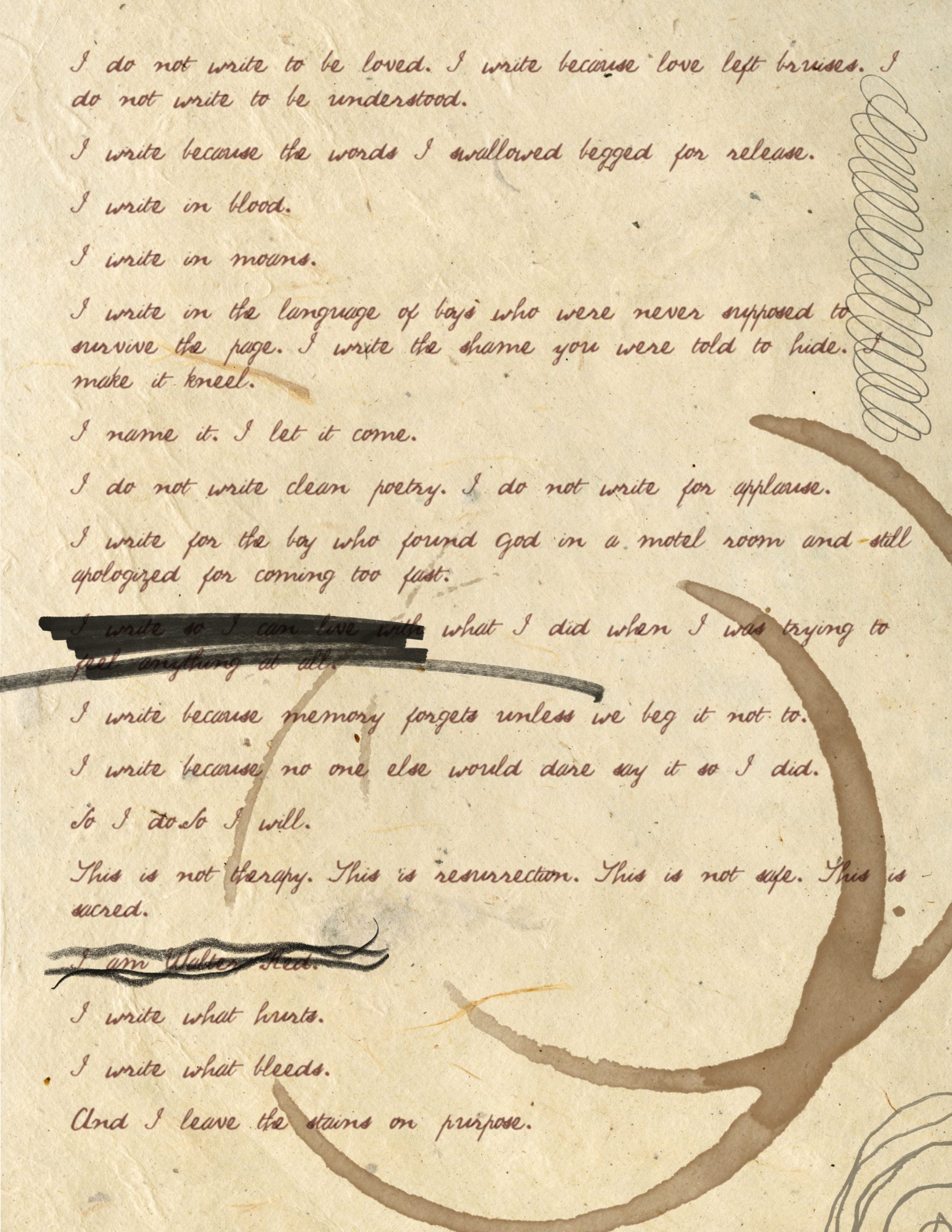
A personal essay reflects on living with depression, self-doubt, and chronic isolation over more than two decades. It describes feeling unseen in social settings, relying on dark humor as a defense, and struggling to have ordinary intentions understood.
The author connects these experiences to self-awareness, rumination, survival mode, grief, and a midlife reckoning. References to psychology, films, and quoted sources help frame the essay as a personal account of learning to name and interpret long-held emotional patterns.
Editor’s Note: This is a personal essay — the author’s opinions and an account of his lived experience, not professional medical or psychological advice. Where it draws on established psychological concepts, those are cited to their original sources so the reader can tell the author’s reflections apart from the research informing them. It is a description of one person’s internal process, set down for the sake of understanding.
Disagreement is welcome; it doesn’t make the experience any less real for the person who lived it. Formal complaints may be escalated to a higher authority — and if He has notes, He’s welcome to contact me directly. Small press. I work every desk myself.
“The most difficult thing is the decision to act. The rest is merely tenacity. The fears are paper tigers. You can do anything you decide to do. You can act to change and control your life and the procedure. The process is its own reward.”
-Amelia Earhart (Amelia Earhart, 1939)
Have you ever stood in a crowded room, looking at all the smiling faces of your friends and family, or the cavalier smug contentedness of strangers sharing intimate moments and just felt completely alone? Those are moments that can crush and destroy a person. That is what it has felt like (personally) for myself living as a writer and person who has lived with depression since I was a pre-teen. 20+ years of feeling like a ghost in the parlor room watching everyone play with a Ouija board to call the spirits when I have been standing there for hours with a white bedsheet with two eyeholes cut out around my head.
It’s close to being a wallflower but a wallflower that has camouflage. I blend into my environments well and have been told by people that they just assumed I was part of the upholstery. Something that has been there for longer than the room existed. While some may say that is an insult, I personally find it endearing to think that people choose to describe me as some sort of ancient presence that has existed since before the dawn of time. On the other side of the coin, it still does act like a small dagger drawn from the ankle and slipped between the ribs.
To be frank and a bit egotistical sounding, through multiple sessions of therapy with different clinicians over the years, I have always asked one singular question:
“Am I normal?”
To which the general response has been “Yes. A little intense and strong-willed, with a full understanding of the world and highly perceptive self-awareness.”. To which I have to question and ask myself, is that even truthful, because that little voice in my head that sounds like my own (strange to think that some people walk around this world without having that inner monologue ever) is always shrieking its head off that I am not worthy of anything more than I am.
Doubting one’s own self-worth is a difficult and painful thing to live with because every action taken, every word spoken, every singular moment of movement I make constantly has me doubting this one question: “Did I do the right thing just then or did I completely fuck it all up?” It applies to the mundane — paralyzed in an aisle, trying to figure out which brand of toothpaste I want to try. It applies to the sacred — the private, behind-closed-doors values of desire and relationships. Constantly questioning every touch, every syllable, every movement of my body makes me doubt my very place in this universe.
Sometimes I say things that are perceived as “too much” or “insensitive.” My natural reflex is gallows humor; a protective shield forged in the dark. I speak this way because I was never taught the delicate, polite language of formal mannerisms. As I’ve come to understand it, at the prime age when those societal values are typically introduced—the crucial window between 6 and 9 years old—most children are being handed a script. They are taught register shifting, the art of non-interruption, and how to gently massage an uncomfortable truth so it doesn’t bruise the listener. They learn how to respond to heavy things with soft, manicured platitudes.
I missed that curriculum. While other children were learning the choreography of “respectful” conversation, I was just trying to navigate the terrain. Without that default programming, my adult life became a constant, exhausting act of translation. When a situation gets tense, my brain doesn’t reach for a polished etiquette book; it reaches for the only survival tool it knows: a dark joke to cut through the noise. But in a room full of people who read the script, my survival looks like disrespect.
Disrespect. It is an extremely strong and powerful word, one that always rides on a horse with its fellow cohorts in tow: shame, discomfort, and doubt. The moment the word hangs in the air, my mind frantically registers what has happened. I realize I have created a massive, unintended rift in a single, fragile moment.
Linguistics are a fascinating but treacherous thing to process because perceptive reality varies so heavily from person to person. A single phrase can have its true intent stripped entirely naked. Taken out of context, a dark comment leaves me standing there, exposed and embarrassed, while the social world points its finger and laughs.
Yet, viewed in context, that very same comment has a completely skewed, alternate value. It is the vast, painful gulf between being understood and being misread. To me, the joke was a lifeline thrown into a dark room; to them, it was a blunt instrument of cruelty. Because I was never handed the traditional conversational rules, I am constantly left at the mercy of this linguistic divide, praying someone will look past the surface of my words and see the context of my reality.
So, let’s round back to that first question that was asked in the beginning.
“Have you ever stood in a crowded room, looking at all the smiling faces…”
To properly explain that sensation I had to dig through my texts with a friend of mine and find this directly to share:
“Have you ever felt alone even in a crowded room? Like, even if everyone is staring at you and cheering you on still, you feel as if though no one is there? That’s what it feels like. It’s like being surround by ghosts that you can never touch or feel because they don’t exist and you’re filling the blank space of memories that you never had as a child. So, you try to think “happy thoughts” but then when no one connects or (so it feels) with you, you feel like you did something wrong without knowing what it was you did.”
The exact context of this conversation is private, but it became a thread of trying to explain to said friend who has a more “positive” outlook on things and does not view the world through the lens of polarity and reality that I do. (We are all allowed to see things differently and I do not blame anyone for potentially disagreeing with how I view it, but it does not invalidate that it is true. Everyone is allowed their own opinions even if it does not settle well with others.)
At one point I had to re-open a wound that was recently (at that time) opened again to heal for once. To send a message to someone about remembering lived experience of childhood abuse is not a text that I thought I would have to send to make someone understand the depths of fear that grip me when interacting with anyone. On the outside I come off as put together, well-mannered, a little quirky at times (the animatronics tend to do that) but inside is an entirely different storm brewing that is silent and loud like the crack of thunder on a clear day. It is distant & terrifying.
Recently I stumbled upon a deeply moving and eye-opening video that touches base on this sensation in cleaner terms that aren’t an alphabet soup in my head. It gripped my attention with just the headline itself: The Terrifying Paradox of Self-Awareness
Taken directly from the videos description online it states the following:
“What happens when a species becomes aware of itself? Self-awareness is often seen as humanity’s greatest gift, the ability to reflect, imagine the future, question existence, and search for meaning. But this extraordinary cognitive power may also come with a darker side. The same awareness that allows us to create art, science, and philosophy also forces us to confront anxiety, mortality, and the vast uncertainty of existence. This is the terrifying paradox of self-awareness.”
The video discusses and touches down with terminology I had previously never had the words to define what these conditions meant as well as the traps that they secretly hold. The topics discussed in it deal heavily with existentialism and deep truth-seeking philosophical concepts that may make others uneasy if they are not versed in those schools of thought. For myself, it was like stumbling upon a miniature Library of Alexandria that could finally complete the Library of Babel that is the inner recesses of my mind.
In psychology, the sensation the video named isn’t a single diagnosis but a set of recognized processes — chiefly rumination, and what researchers call heightened self-focused attention.
For the cheap seats: it’s not a diagnosis, it’s two normal brain settings cranked past eleven. One is overthinking — your skull gnawing the same bone for hours like a dog that won’t drop it. The other is self-watching — you’re so busy narrating your own life that you never live a second of it raw, because there’s always a tiny version of you up in the rafters with a clipboard, grading the performance.
tl;dr (that means, too long didn’t read):
Everyone’s brain does both. Some of us just run at full volume, all the time.
As I sat there suddenly enthralled by this psychotherapy late night feature (clocking in at 30 minutes or so) I kept reaching for a word that wouldn’t materialize in my brain at 3:12am.
Recognition. That is the sensation that crashed over me like a summer rain out of a clear sky. It is something that I tend to disregard when people attempt to compliment me or give me praise. Those that know me well, know that I do not take praise and compliments well and pass them off with sarcasm and hubris to avoid accepting it. (This is something I am actively working on getting better at slowly yet surely.)
At a young age, most of the memories that would normally invoke that feeling is stained with fear, embarrassment and guilt. To grow up constantly making yourself believe that you were a mistake deteriorates something in you. And it is brutally hard to correct a mind that runs advanced trigonometry while everyone else is playing checkers.
The connective tendons that still show my willingness to just keep marching on suddenly had a name as well. Something that I had come to know all too well since day one itself of life. Survival Mode ™. This is a term that I hear a lot when the topics that surround these essays. Beforehand when I would hear that term being used, I found it confusing in context. Not because the words themselves didn’t collaborate like two hunters waiting in the high grass. Grammatically and descriptively, it works way too well. It invoked the idea of “this isn’t normal mode” in this game I’m playing. This is the big leagues and I’m up to bat against the world who keeps throwing curve balls my way.
For having a larger than normal vernacular, you would honestly be surprised by how often words just exist in my head. Maybe it was also just casually reading the dictionary as a kid because I was curious. A dear friend of mine likes referring myself akin to a “potato bud”. (That’s the weird freaky little “eye” that grows.)
At the other toss of that coin, it took me well over 37 years to finally begin to understand what grief meant. Shocking, I know. A man who is a wielder of words that hold the weight of a sword didn’t understand the exact defining term of what he was expressing to the masses. Stop the press and alert the producers, The Truman Show would like words. (Yes, I have seen Eternal Sunshine of the Spotless Mind as well. Incredible film.)
Yet here is the surprising part about having seen those films, those simple moral and philosophical ideas of living didn’t sit and merge into me. They acted like oil and water – two truths in the same glass, refusing to blend, one never willing to admit the other was right. One that felt like racoons in a trenchcoat and the other a flesh walker trying to act like a human. Silly paradoxes and metaphors that don’t work together.
This last year has been a journey of fundamental learning. It has meant taking the Felix the Cat clock in my mind – those shifting, judgmental eyes, that incessant ticking echoing through the halls like a grandfather clock in an empty house – lifting it off the wall, and smashing it to pieces.
On this season of Passions, we had drama, forbidden love, betrayal, and the always cherished & beloved self-doubt happen. Yet at the same time there was a zenith moment that collapsed everything within itself. Liminal rupture. More commonly known as a “midlife crisis”. Whodathunkit. 36 years old and absolutely no idea in the world what I wanted to become or do.
That was when clarity took the mirror and shone the light directly into my corneas. Blinding me with another realization that no one teaches you that life is frankly terrifying when you pull back the layers of bullshit handed to you. The one thing that no one knows how to handle and exist at the same time is living on borrowed time. Take a moment and think about the absolute terror of collapse that can happen unexpectedly when you thought you were already at rock bottom.
forevermore, Jared Michael

“DON’T THINK OF IT AS DYING, said Death. JUST THINK OF IT AS LEAVING EARLY TO AVOID THE RUSH.”
— Terry Pratchett, Good Omens
Works Cited
Aperture. “The Terrifying Paradox of Self-Awareness.” YouTube, 8 Mar. 2026, youtube.com/watch?v=3x6hiS0E_7w.
Eternal Sunshine of the Spotless Mind. Directed by Michel Gondry, Focus Features, 2004.
Ingram, Rick E. “Self-Focused Attention in Clinical Disorders: Review and a Conceptual Model.” Psychological Bulletin, vol. 107, no. 2, 1990, pp. 156–76.
Nolen-Hoeksema, Susan. “Responses to Depression and Their Effects on the Duration of Depressive Episodes.” Journal of Abnormal Psychology, vol. 100, no. 4, 1991, pp. 569–82.
Passions. Created by James E. Reilly, NBC, 1999–2008.
Pratchett, Terry, and Neil Gaiman. Good Omens: The Nice and Accurate Prophecies of Agnes Nutter, Witch. Gollancz, 1990.
Putnam, George Palmer. Soaring Wings: A Biography of Amelia Earhart. Harcourt, Brace, 1939.
The Truman Show. Directed by Peter Weir, Paramount Pictures, 1998.