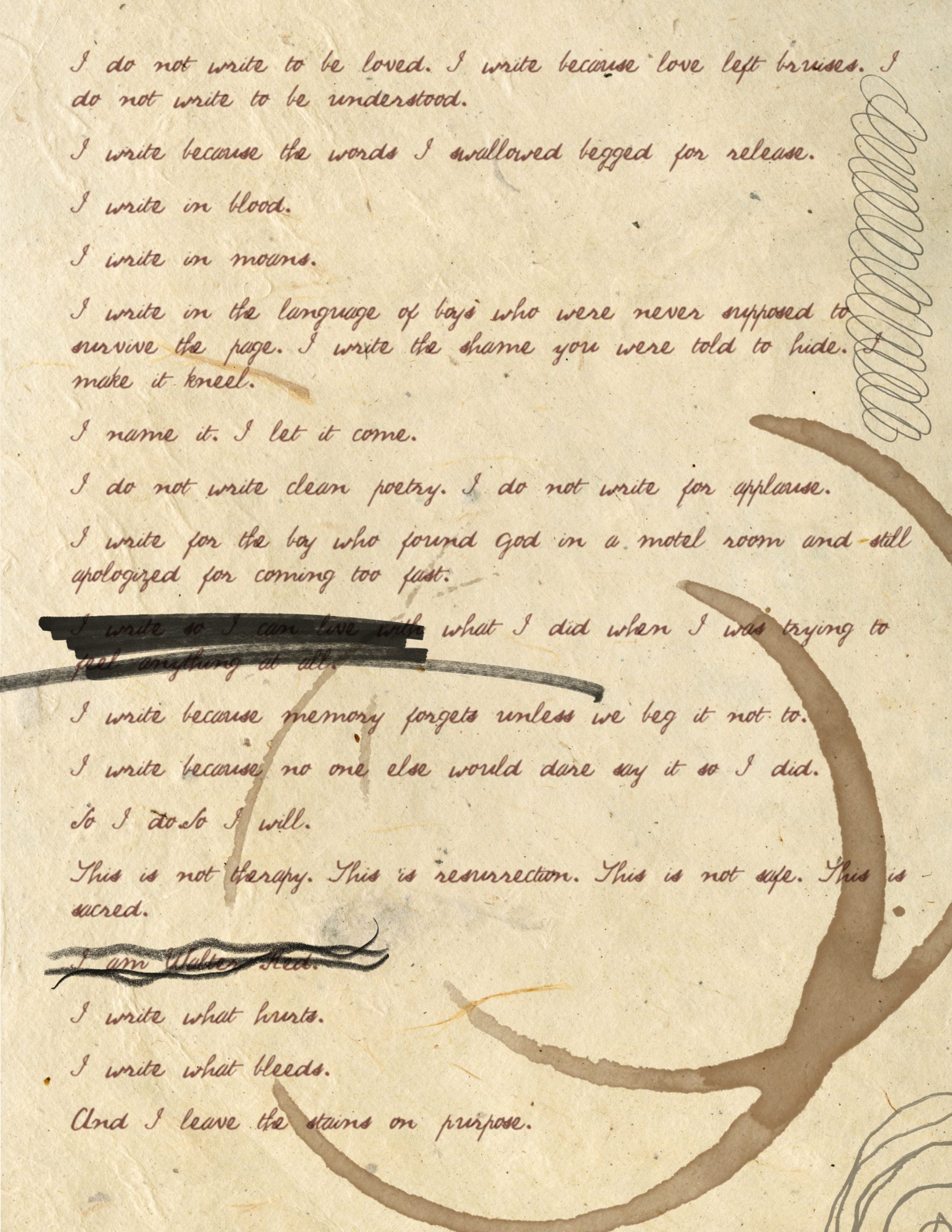
A reflective essay traces the author’s long experience with depression, anxiety, trauma, abandonment, and repeated encounters with suicidal thoughts. It interweaves personal history, mental health statistics, and dark humor to describe how childhood upheaval, bullying, and isolation shaped a lifelong struggle.
The piece also follows moments of creative recognition, friendship, and attempts to build community, alongside multiple crises in adulthood. It ends with a guarded note of gratitude and a tentative commitment to accept help while continuing to recover.
They say it gets easier the longer you live through life and all its trials and tribulations. That’s far from the truth when you’re also living with severe depression and anxiety, piled on top of years of trauma that still hasn’t been fully resolved. Add a little extra zest from the effects of a premature birth and some abandonment issues, and you’ve got yourself a real party.
This essay isn’t here to blame or pass judgment on anyone; it’s simply a writing exercise — a way of laying my own ghosts to rest, finally. A love letter to no one and everyone at the same time. The experiences described here are solely my own personal memoirs, a testament to having lived a full — and equally disorienting — life of adventure and more.
The NIMH defines it this way: Depression (major depressive disorder) is a common and serious mental disorder that negatively affects how you feel, think, act, and perceive the world.
According to a 2023 Gallup survey: Nearly three in ten adults (29%) have been diagnosed with depression at some point in their lives, and about 18% are currently experiencing depression, according to a 2023 national survey. Women are more likely than men, and younger adults are more likely than older adults, to experience depression. While depression can occur at any time and at any age, on average it first appears during one’s late teens to mid-20s.
• • •
For roughly twenty-one years, I’ve lived with what clinical psychologists and therapists have called “SAD” — Seasonal Affective Disorder — along with anxiety. It started around 2002, when my father abandoned my two brothers and me, eloping with a woman he’d met online from Canada. For a few months during that transition, we stayed with our grandparents while the rest of the family held closed-door meetings about what to do with the three of us. Every family already had their own children to raise, and taking on three more without any financial support coming in would have been too much. So, the decision was made to separate us — the youngest going to one family, and the twins kept together with relatives closer to our own age.
• • •
My first year of high school started off horribly. At eleven, I’d suffered a hairline fracture and nearly shattered my kneecap at the local pool with my brother and spent the first few months of school on crutches. Then something happened. I won’t go into the details of the bullying and the things that were said to me at that age — school kids are cruel, and it’s funny how, years later, you’ll get a friend request out of the blue from one of the people who bullied you. (“Good to see you have kids and a wife now, [insert name here],” or the classic of learning they just got out of jail.)
There was a football player, Tim, who decided to be a real jerk — he lifted me up off my crutches and hung my backpack by its hook from the gymnasium’s pulley opener. I was stuck, and no one knew what to do. Some people laughed and snickered; others looked away in shame. My two friends tried to help, and while I struggled — turning red with embarrassment — I managed to slip the backpack off. The landing wasn’t graceful. My leg straightened out and took the first impact, sending a shooting pain through my entire body. Did my knee just blow? I thought, trying to make sense of what was happening, tears running down my face, screaming in pain.
It became a whole ordeal. The moment I hit the floor; I didn’t fully understand what was happening. Two older students flung the gymnasium doors open and pulled me inside, away from the commotion in the hallway, asking if I was okay and what had happened. I told them the truth — I had no idea why he’d done it. I was picked up from school and taken to the doctor, who ran some scans and tests to make sure nothing was broken; luckily, nothing was. Tim got a three-day suspension. I got a note excusing me from leaving class a little early or late to get between periods.
Once I’d healed and was back on my feet, I got more involved — choir, and the forensics team (a fancier name for debate club). Around that time, I was writing poems — not the greatest, but not the worst either. While living with my aunt and uncle, I noticed a local poetry contest and showed her one of my pieces. She approved of entering. We polished it up together; the exact poem is lost to time now. Eleven years old and submitting to a poetry contest. First prize was a fifty-dollar gift card, your poem printed in a book, and a few other things, I believe. Second place got you printed and a twenty-five-dollar gift card or something — the details don’t really matter. Once we finished the rewrite, sealed it in the envelope, wrote out all the information, and stuck on the stamp, I waited patiently every day for the mailman to bring good news.
It took a few weeks for anything to show up. Every day, when they got the mail, I’d ask — “anything for me?” — and there wasn’t. It crushed me, every time. The first real taste of rejection for not being a good poet. Then one day the mail came, and I was handed an envelope with my name on it as the recipient. Who’s sending me mail? I opened it, and as my eyes moved down the page, they went wide. I’d won. Not first place, not second, not third — but runner-up. That didn’t matter to me. What mattered was being recognized at all. Some kid who wrote a poem at eleven had won a contest. I never won anything competitive — must’ve been all those ladders I walked under, or mirrors I accidentally broke.
The letter sent back a copy of the poem with a stamp of recognition, along with an invitation — to buy the book and see my work in print for the world to see. It cost around fifty dollars, if I remember right, and wasn’t very big — more like a thin coffee-table magazine. That didn’t matter. The fact that my writing had been printed in a book felt like everything.
This ties into the high school stuff, because not long after I’d healed up, I decided to start an unofficial Poetry Club. I printed a stack of badly put-together flyers and taped them up on lockers all around school — my big moment, I thought. If I can get published, I can start a club! I was dead wrong.
Not even a day after papering the school with flyers, I was called to the principal’s office. Oh no, I thought — I’m in trouble for the bully thing, or something my twin did. Nope. It was because I hadn’t gotten permission to put up flyers. I was confused at first, since I’d seen other students do it, but I learned there was a process — a signature in the corner, and I could re-post them.
There was a turnout I hadn’t expected at all. I figured a few people would show up; I was dead wrong about that too. More than twenty people came, and I was a one-man show trying to piece together a club on the spot. My greatest failure moment, rubber-stamped with my face glowing bright red. The club itself never became much more than a few of us hanging out, and someone else eventually took the reins — I wasn’t fit to run the show, as I recall.
The one good thing that came out of it was that I made a few real friends for once. Fast forward twenty-plus years, and I was rewriting my juvenilia volume of poetry when I stumbled across a photo of that club in a high school yearbook. One of the other students in the photo I’d stayed in touch with over the years; the other two I could never find online — until recently, when I finally struck gold and found them.
• • •
From there, life became a whirlwind — one tragedy falling like a domino into the next. At fourteen, I stood in front of a camera, told to stare forward and smile. A bright flash blinded me as the receptionist told me to step off the stand. Minutes later, I had a laminated card in my hand with my name and address on it — my first ID. Then suddenly I was standing in an airport with multiple bags, all my belongings stuffed into a half-decaying bowling bag, scared, with my twin brother, trying to figure out where we needed to go for our flight.
I remember sitting in my seat on the plane, tears streaming down my face as I looked toward the front, trying to get my things stowed under the seat. A flight attendant — kind and sincere — asked how old we were and where our parents or guardians were. I told her there weren’t any. She looked visibly concerned and went to the front of the plane. They came back and spoke to us, and I handed them a letter that explained everything. We were headed to Ted Stevens Anchorage International Airport, where our mother would pick us up.
We’d flown before, as toddlers, between Anchorage and Wisconsin — but this time, with life crashing into me at full force, it was different. Foreign. Terrifying. On liftoff, that same flight attendant noticed my ears wouldn’t pop, and gave me a piece of gum, telling me chewing would help release the pressure. It worked — though the tears streaming down my face made the gum taste salty.
• • •
This was the fissure point — where the ever-creeping darkness began to slowly, silently grow, for years to come.
My first attempt at suicide was around age fifteen, during my sophomore year of high school — one year into living in Alaska with my mother, after more than ten years apart. No one knew it happened, and I never told anyone, until now. It wasn’t to be dramatic, or a cry for attention — it was an immense, deep sorrow that washed over me constantly, one I tried to hide behind a fake smile that said everything was fine. I didn’t want anything dramatic, like a slit-wrist scenario — something more subtle, that no one would notice. We lived about thirty minutes outside Anchorage, in a small community called Bird Creek, tucked into the tree line. Driving south from Anchorage, you’d never even know there were houses back there. To the right of the highway was the Cook Inlet.
• • •
Fun Fact: Alaska has the largest amount of below-freezing water temperatures in the United States, with water temperatures averaging 32°F.
The idea was simple, but the most painful way to go. Did you know that the human brain is still active for up to ten minutes after the heart stops, when you drown? So even though your heart has stopped beating, your brain is still processing everything. Fascinating stuff, right?
Death has never truly scared me. Having nearly died at birth seems to have stripped that fear away — or maybe I just realized early on that my mortality has always been inevitable, something I can never escape, so it’s better to embrace it before it eats me alive.
My first funeral was a strange one. It was for my uncle’s father, in another town, where I didn’t know anyone. I remember being handed my Game Boy Color and playing it for most of it, not really understanding why I was there. It was an open casket — the first time I’d ever seen a corpse, and not the last. It was a strange sensation, seeing someone existing but not, if that makes sense — unnatural, uncanny. Morticians do a phenomenal job making people look real after one of the most intense and intricate dissections a body goes through — making someone look warm, when the true look of a body is nothing like that.
I kept expecting him to wake up and say “surprise” — but, luckily, that never happened. Over the years, death has always felt like it’s been there in the corner, patiently watching me. I’ve had my own near-death experiences, and my own attempts to end things. Yet every time, without fail, something has managed to be the saving grace — the miracle — that pulls me out.
• • •
If you know me well, you know I speak with dark humor, head to toe. It makes other people uncomfortable sometimes, but it’s never truly bothered me. I’ve come to embrace it more than anything, knowing my mortality will catch up with me one day.
The last attempt — the bleak, bottom-of-the-barrel kind — was back in 2017. I was living that summer out of a tent behind the airport, because I didn’t want to leave the woods, where I’d found comfort and spent a lot of time working summers in Kenai and winters in Colorado. This wasn’t rock bottom yet, but it was a fissure starting to crack the foundation beneath me. My tent had been broken into one night — likely by a wild animal, I figured — and a storm had just rolled in over Anchorage. I had nowhere to go, and no one to really ask for help. I’d bought a beater truck and was just scumming it up without a care in the world.
Then one day I woke up and set the first domino in motion — something I’d been planning for a while. I won’t get into the details; they’re not relevant, and they’re extremely private. The first “riddle” went out, and no one noticed. Give it a few hours, I thought, and drop another hint. Again, no one took the bait. Time to escalate, my brain said. The hands on the internal doomsday clock ticked two seconds closer to midnight. I was half-drunk and emotionally raging, to the point that I decided to take a long-distance bike ride to let off steam. (Impatience isn’t my best feature.)
Then my phone went off — an unexpected person I barely knew had reached out. I asked him what he knew, and why he was even reaching out. He said he was genuinely concerned — no one had told him anything, but he’d pieced it together himself. This is the closest I’ve come to getting thrown into the grippy-sock ward, because a trigger-happy police officer was ready to do the waltz with me.
He invited me over, and we sat around and had some drinks, and I cried. Ugly. Really fucking ugly, from the soul — the kind that hurts. This poor man had only met me once before — a friend had heard about a tattoo artist doing work out of his garage, and I’d been invited along. His parents were back from snowbirding or whatever, so we ended up camped out in the RV in the driveway. After a heavy, severe crying session, there was suddenly a knock on the door. Being hammered isn’t pretty — fun, sometimes, and quirkier than usual — but when that door opened and I tried to stare, cock-eyed, at this man in uniform, it was a mix of horny and oh shit, what are the cops doing here, sobering up fast.
• • •
Someone had cracked the code too, and reported to the police that I might be a danger to myself. The thing is, no one knew where I was — absolutely no one. My friend was completely thrown by the whole thing. One officer was kind and supportive, joking about my drunken state, while his partner looked ready to cuff me and throw me in the drunk tank. Slurring, I told them I was okay — I’m sure it didn’t sound coherent — and my friend backed me up, saying he’d keep me overnight and keep an eye on me. I passed out the moment they left the RV.
I woke up the next morning with a raging hangover. Fast forward to the last few years, since the 2020 pandemic. During the lockdown, for the first time in over eight years, I wanted to die. I thought about throwing myself out of the sixteenth-floor window of my building, but I didn’t. The thought passed not long after — until recently, when I hit a low point on top of a lot of my own personal life already in shambles.
December 2025 was already rough — I’d learned that my partner wanted to initiate Death with Dignity (medically assisted death is legal in Washington), and it crushed my spirit, on top of everything else I was dealing with. In January 2026, I said out loud, in front of a room full of people, with fire behind my voice, that I wanted to fucking kill myself — because honestly, things would be easier without me dragging everyone down.
I left the room in a storm. No one came after me, and no one reached out afterward to see if I was okay. Did it hurt? A thousand cuts, between the ribs.
• • •
And yet — I do have people who genuinely care about me. Just not, in that moment, in the capacity I needed. And honestly, even now, I still don’t know what that capacity is.
This past year has been an extremely trying time — resigning from my previous job, building my LLC from the ground up, and trying to repair things that can’t be fixed. But it’s also taught me a lot about myself. I’ve worked hard at getting better, and still, without fail, I’m not invincible. I fall.
When I do, I tend to refuse help from others. I’m slowly trying to open myself up to accepting the support that’s there. So — thank you, to anyone who made it this far, and to those who’ve been here since the start.
There are many more suns and moons to watch crest and fall in the sky, together.
Forevermore,
Jared Michael
Works Cited
“U.S. Depression Rates Reach New Highs.” Gallup, 17 May 2023, news.gallup.com/poll/505745/depression-rates-reach-new-highs.aspx.
National Institute of Mental Health. “Major Depression.” NIMH, U.S. Department of Health and Human Services, www.nimh.nih.gov/health/statistics/major-depression.