A tense dinner invitation collapses when the host fails to disclose an extra guest until the narrator arrives. The evening follows a medical scare at home, mounting confusion, and a confrontation that ends with the narrator being told to leave.
The piece reflects on the incident as a breach of courtesy, trust, and accountability. It argues that the real issue was the host’s refusal to name the situation directly, turning a brief dinner into the decisive end of a long relationship.
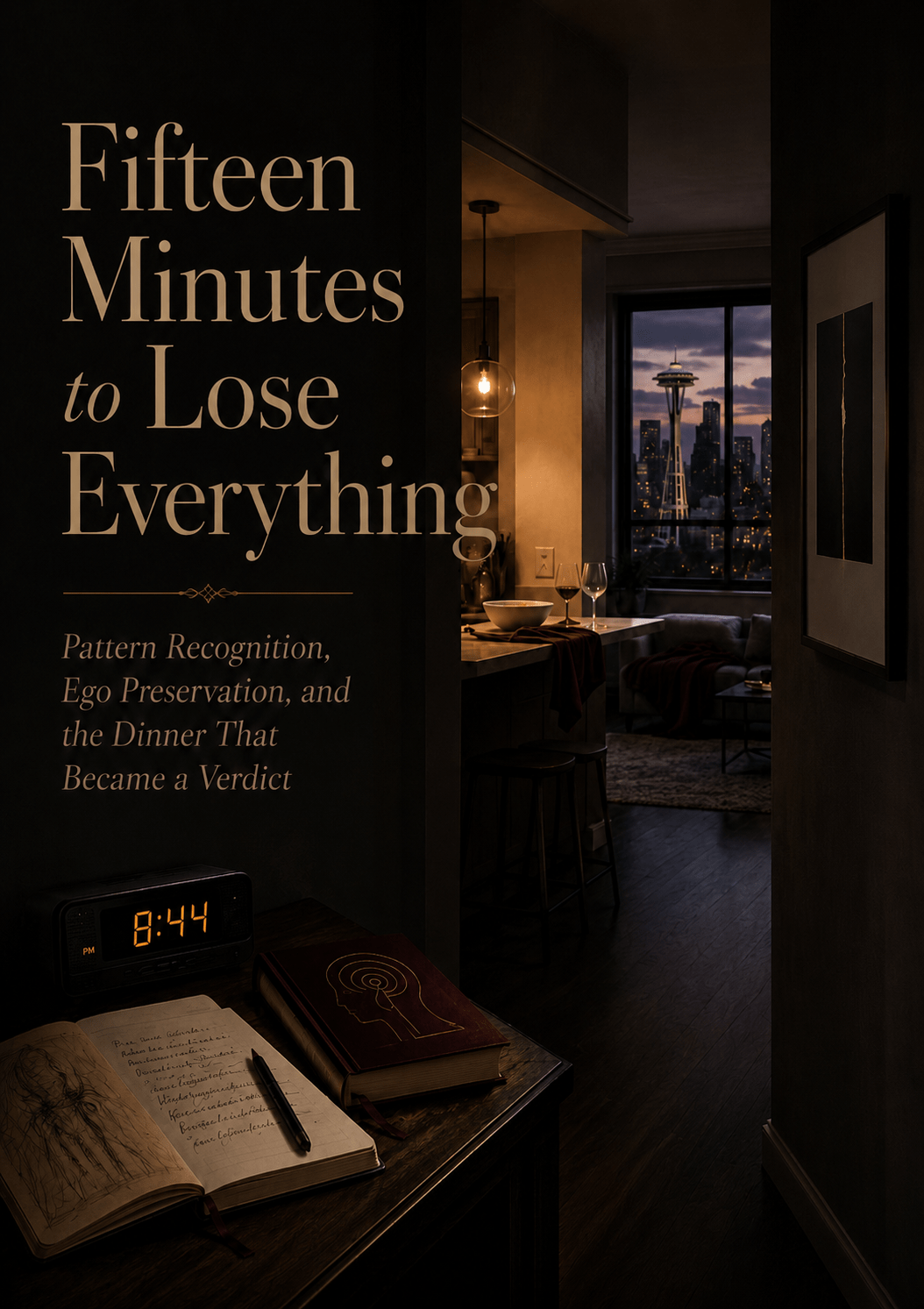
To say that I felt like the world’s biggest asshole would be nothing short of correct, but that was far from the point at hand. The room had completely shifted within minutes, and every second felt more like it was hours.
Upon sitting down to write this essay and compiling final corrections to the documented case study file and searching for timestamps and correct dates of how that moment had entirely cascaded itself into oblivion had me sitting there bewildered.
It took less than 15 minutes for everything that had been worked on in nine months during a 2 year, 8 month and 6-day relationship to completely collapse into the void. If we truly do the technical mathematics, it rounds out to about roughly 11.59 minutes that it took from entering the room to exiting not including the time from the main floor of the building to upstairs and back down.
15 minutes. Let that sit with you. What was supposed to be a dinner with someone the author has had a rather intrepid relationship with ended in that timeframe unknowingly at the time. A week prior they were celebrating a birthday, jovial and prospering in unwinding after the small gathering had begun to clear the room. Before entering the elevator to the ground floor, the host of dinner asked the birthday author if he would like to have dinner next week, say, June 23rd at 8pm. The date was set and agreed upon. This was the first time concrete plans had been ever made without having to feel like it was pulling teeth.
“Italian treats.” It was repeated in a text asking to confirm the date over as to not forget. A friend had baked an abundance of cupcakes, cookies and cake and they had forgotten to take some. A text sent asking if they would like them to be hand delivered or possibly dropped off so they wouldn’t have to detour out of their normal route. A polite decline for the night was sent in reply. The next day a request to come by the next day and grab some. “Sure, there’s a lot left over.” Was sent in return.
The following day a building pass was created and sent. No response typically needed to make someone understand this means access whenever you want to come by. The building pass went unused all day with no response returned either. Until the night before dinner was supposed to happen.
“Sorry about the cupcakes! Confirming tomorrow for 8pm!” It had been 4 days since the original cupcake text had transpired. The cupcakes were already in the trash alongside the rest of the baked goods. “Ok. See you guys at 8pm!” Take a moment to recognize the plurality of the usage of “you guys”. The original dinner was originally thought to be a private affair, just two people enjoying dinner. Sent more as a probe to detect reaction, no response came back.
The terms and conditions of that silent contract seemed to have never been disclosed. What happened next is how the beginning of a 15-minute slow burn turned into complete collapse after and the damage that can never be repaired.
I didn’t know that there was a medical emergency unfolding in my living room as I got out of the shower when my friend came over that afternoon. Not until I walked into the living room and found them panting for air. We have a small medical kit in the living room that has the essentials (thermometer, blood pressure cuff, blood oxygen monitor, etc.) that I quickly grabbed the thermometer and took their temperature and slipped the cuff on his arm. Am I medically trained to be administering this kind of care? No. Do I have knowledge in it? Yes, surprisingly. He was running hot, almost peaking at 100 degrees, blood-oxygen fine, blood pressure – not so fine. The numbers were irregular and not the comforting kind.
First impressions was this is a person experiencing a heart attack. Chest pain, tightness, overheating. My husband on the other line even agreed at one point and said get hI am to the hospital. I was set to have dinner in a few hours. This can’t be happening right now I kept thinking to myself.
My friends health was more important than dinner I told myself attempting to stay calm under the pressure building. Cold compresses and air conditioning seemed to help quell his flashes and tightness, which had been happening since the night before I learned. Should I call the paramedics? The hospital is only a 10 minute walk from here I kept wondering. He said he was fine. He was not fine in fact.
The ice packs helped with the heat and the chest complications he said and suddenly the next moment he was dozing. Vitals normal and breathing. My husband was on his way home already to help because I didn’t know what to do and I was all by myself with them. The clock started ticking louder in my head. 7:25pm Dinner is at 8pm.
I have already changed my shirt twice now because it is an extremely warm Seattle day hitting almost 90 degrees. My bag is packed and ready on the bed; sketchbook, laptop, journal, pencils and a gift. The Red Book by Carl Jung. Not my personal favorite type of literature honestly, but the host of the night is a psychotherapist and would appreciate it I thought to myself.
My phone suddenly pings a text message tone. Not the default. A specific tone associated with someone. I groan immediately because I know what this means. Cancellation or delay. The screen lights up and read: “Hey! My 6pm clients took a little longer than anticipated. Is it okay to push back till 8:30pm?” Classic, I mutter to myself. “Anticipated, but sure. See you at 8:30pm.”
I now have little under an hour to get myself ready and prepared for dinner and braving against one of the more steep hills in Seattle. This is the third time that I have changed my shirt today I thought to myself. Quick shower to rinse off the new layer of sweat from all the excitement in my home happening. My friend finally says he is going to go to the hospital. Thank god and finally after some stern talking to from my husband.
The time is now 8:00 when dinner was supposed to happen. It’s only a quick 10 minute walk to their place from mine. I gather my things and walk out the door after briefly talking with my partner. “I’ll let you know how it goes. If you get a text that says “three’s company!” you’ll know I’m on my way back.” I recall saying as I walked out the door.
A joke said into the wind as a cautionary tale. Soon that tale would become reality.
Arrival is earlier than anticipated to the building, its still sweltering outside and I am yet again sweating through another shirt. Text alert: 08:23pm “Let me know when you’re outside the building! The callbox is broken.” Response: “I’ve been here for 10 minutes.” Response: “Oh. Let me get myself together then!” I groan. Yet another classic pattern I’ve come to learn and anticipate exactly on time. Only one more new pattern that hasn’t been confirmed I think to myself hasn’t happened yet I thought to myself.
Response comes through about getting buzzed in, and I enter the building. Time: 08:32 Elevator Up! I punch the floor number and start ascending. Wait, did I hit the right floor? Ive only been here once before. Luckily I have the address written down in my journal. I fish around my bag to find it, the elevator doors open. I sent a text on the way up asking for confirmation of the floor. Open the journal and yes, correct floor.
Hmm, that’s strange I think to myself. I suddenly hear voices coming from their unit. I silently listen trying to register the voices. Correct, that’s the host’s voice. Then a second voice responds to them, and its one I haven’t heard before. Strange I think, maybe it’s the tv? No. He doesn’t have a tv. His friend who has been staying with him? No. Not the same voice tone as his. Really strange I think to myself. So I decide to pocket the incident and not care. Someone is pacing up and down the entryway I can hear, the peephole window flipping open and closed.
A text notification goes off so loudly it could have been lightning in a bottle. It echoes throughout the floor entry. Suddenly the voices both stop and the footsteps come down the entryway. I knock on the door. It swings wide open and the host is smiling and greeting me. I am sweaty and warm and trying to not think about the voices I just heard. I cast a half-smile and walk in.
This is the moment when the room shifts. The moment when the countdown starts.
Time: 08:33pm I strip my boots off and walk down the darkened corridor towards the kitchen, anticipating to uncover the mystery of this mysterious voice. The living room opens into view, and nothing. Not a soul. Just the Seattle skyline greeting hello at dusk. Strange I think to myself, I swore I heard, whatever. I walk towards the couch, pulling the book out of my bag and tossing it on the couch. “Can I get you something to drink?” No, I’m fine. I have my water. I swing my sticker plastered water bottle around my finger and sit.
08:35. Still sweating and still running on high from the medical event that just happened at my house. The host looks at me and says “are you alright? Something seems off. We can reschedule if you want.” I will state the fact cleanly. Rescheduling this dinner would have never yielded an actual date if I had rescheduled this under any circumstance. This is well documented. “No, its fine. Just had a really rough afternoon.” He seems displeased about my answer and heads to the kitchen. I pull out my sketchbook to do some work on the drawing I have been working on for them as a birthday gift in August. 08:38. Small talk is happening and I have not looked up, my pencil focusing on work. Suddenly in my field of view above the book a body appears.
I look up and my eyes widened like dish plates. Immediately my whole body goes stiff and my color became solid and sank through my throat to my stomach. What is happening? I thought to myself. Is this real? The body then lays down on the couch casually. The host calls from the kitchen “oh, do you know [REDACTED]?”
“No.” I stammered flatly with disbelief caught on my tongue. “I. I’ve seen them on your facebook though?” That is a statement and question both fighting to get out of my throat. 08:39. Random question is brought up about a friend who was at my birthday party the week prior. The stranger tries to make small talk with me: “I like your tattoos.” I stared up cold and blank “thanks.” Is all I could muster to say. 08:40. Every minute suddenly feels like it’s an hour that hasn’t finished and the hand of the clock is just stuck there not moving. I quickly think to myself what the fuck is happening and what do I do?
I promptly stood up. Bag still around my shoulder as I hadn’t taken it off yet and I walk to the kitchen. I stop in front of the host and stare. 08:41. “I can’t do this.” I managed to spit out. The host looks at me confused. “It’s typically common courtesy to tell people when there is extra company to dinner.” This has been verified and confirmed by many outside sources to be true. The tension in the room is now past boiling and there is anger in the air, you can feel it.
An exchange of words happens very fast. There is a fourth person missing, and no one knows where they are. “They are leaving after dinner.” Is the response. I am in disbelief. The room shifts again. “I can leave. I feel like this is really awkward already.” The stranger says. “No. You are staying.” I am shocked but not bothered, as I was the one invited to dinner but not informed of this special guest, and I am attempting to remove myself to clear the room but am not allowed grace? A tinge of betrayal hits.
“You had a whole week to tell me. And you decide this is the best idea to do? It’s common etiquette…” Utensils are thrown into the bowls and things in the kitchen are starting to get tense. 08:42. The stranger is trying to stand up for me and calm the host. I am still in shock. The room is buzzing in my head I can barely hear anything.
“Get out!” are the next words I hear. My heart stops beating for a split second. I am staring directly into his face, a face I have never seen before. I was not terrified of him, but I was terrified of the face I was staring at. The drawing was cut out silently and placed on the counter. “I was going to finish it for your birthday but I guess not.” No response. The host is back to making food angrily. I want to speak, but the only thing I realize I can say is this.
“I really was looking forward to tonight all week.” My words falling flat.
“So was I.” the host said. Their words sounded like they were soaked in grief falling from their mouth. His face never making contact with mine. I turned and walked to the entrance and put my boots on and stopped. Don’t look back, I told myself. I opened the door and the weight of it slammed shut on me. The stream of tears running down my face suddenly. 08:44. The elevator is called. A phone call made and hung up on almost immediately. I rush home in shock, dismay, disbelief and sweat.
And that was dinner.
Not the food. Not the table. Not the Italian treats. Not the ordinary social ritual everyone pretends is simple because society has somehow agreed that a meal can be both intimate and casual depending on who wants plausible deniability that evening. Dinner became the door closing. Dinner became the elevator button. Dinner became the walk home with a body still overheating from the weather, the medical scare, the shock, and the sudden knowledge that the night had not merely gone wrong. It had revealed itself.
That is the part that makes the whole thing difficult to write without sounding theatrical. The event was not long enough to earn the size of its consequence. There was no sprawling argument. There was no hour-long confrontation. There was no dramatic final speech, no grand exchange of truths, no operatic destruction in five acts. It was less than fifteen minutes. It was closer to twelve. A relationship that had accumulated years of intimacy, silence, repair attempts, symbolic objects, promises, letters, returns, tenderness, dread, and unfinished questions hit the floor in the time it takes water to boil.
That is why the number matters. Fifteen minutes is not just a measurement. It is the shape of the absurdity. It is the killing joke hidden inside the evening: not a joke that makes anyone laugh, but the bleak punchline that arrives when the pattern finally becomes undeniable. A joke had been made before leaving the apartment: if the text says “three’s company,” then the prediction came true. It was said lightly, because sometimes the only way to touch dread is to put a clown nose on it and pretend the room is not already on fire. Then the joke stopped being a joke. It became evidence.
Pattern recognition is not wizardry. It is memory doing math. It is the mind taking prior delays, prior omissions, prior evasions, prior soft disclosures, prior “I’ll let you know” clauses, and building a probability map while everyone else is still pretending the weather is random. The problem with recognizing a pattern before it happens is that people can mistake it for paranoia right up until the pattern is lying on the couch.
The issue was never the stranger as a person. That would be the easiest and laziest version of the story, and it would also be false. The stranger was not the structure. The stranger was the reveal. The breach was not that another person existed in the room. People exist. Tragic, but documented. The breach was that the terms of the room had been changed without notice. The dinner had been framed one way, lived toward one way, anticipated one way, and then delivered under undisclosed conditions. That is not neutrality. That is withholding material information and calling the other person unreasonable when they react to finding out in real time.
Common courtesy is not a decorative social flourish. It is a basic consent mechanism. “There will be someone else there” is not a difficult sentence. It does not require a tribunal, a notary, or a sacred cow dragged into the kitchen for ritual approval. It is a sentence that gives the invited person the dignity of choosing whether they want to enter that situation. Without it, the choice is made for them. The room becomes a trap not because anyone necessarily intended cruelty, but because intention does not erase impact. A locked door can still be locked even if the person holding the key insists they meant well.
That is where ego enters. Not ego as confidence, not ego as ordinary selfhood, not ego as the basic human need to remain intact. Ego in the uglier sense: the little internal courthouse that would rather burn the records than admit the charge has merit. To answer the obvious question would have cost something. It would have required admitting that the omission mattered. It would have required saying, yes, I should have told you. Yes, I changed the terms. Yes, I understand why that made the room unsafe. Instead, the question was sidestepped, the reaction became the problem, and the person naming the breach became the disruption.
That is the oldest trick in the collapsing-room handbook. Do not answer the substance. React to the tone. Do not address the choice. Address the discomfort created by someone noticing it. Do not say, “I failed to tell you.” Say, “You are making this awkward.” It is a beautiful little machine if one enjoys emotional machinery designed by raccoons with law degrees. It converts accountability into inconvenience and then invoices the injured person for the noise.
The stranger, ironically, seemed to understand the social problem faster than the person who created it. “I can leave. I feel like this is really awkward already.” There it was: the grace the room needed. A simple attempt to reduce harm. But even that was refused. “No. You are staying.” The invited guest was not granted the grace of disclosure. The unexpected guest was not granted the grace of exit. The host chose control over repair, pride over de-escalation, and image over the very small sentence that might have stopped the whole thing from detonating.
That is why “So was I” lands so strangely. “I really was looking forward to tonight all week.” “So was I.” Maybe that was true. It sounded true. It sounded grief-soaked. It sounded like a person who also knew something had gone terribly wrong. But wanting the evening to go well does not absolve the choices that made it impossible. Desire is not accountability. Anticipation is not courtesy. Missing the outcome is not the same as protecting the person who trusted the invitation.
This is the hypocrisy at the center of it: the self-image of being thoughtful, perceptive, emotionally intelligent, flexible, and relationally skilled cannot coexist cleanly with the refusal to perform the smallest act of relational decency. So the psyche does what psyches do when cornered. It protects the image. It preserves the preferred story. It makes the other person too sensitive, too intense, too reactive, too difficult, too much. Pride does not always roar. Sometimes it cooks angrily in the kitchen and refuses to look at the person it has just wounded.
The fifteen minutes did not destroy the friendship by themselves. That would be too simple. The fifteen minutes exposed that the friendship was being held together by one person’s willingness to keep translating vagueness into hope. The room did not create the fracture. It made the fracture visible. It took the invisible pattern and staged it with lighting, blocking, dialogue, and the world’s least requested guest appearance.
So no, this was not about etiquette in the shallow sense. It was not about wanting perfect hosting manners or demanding ceremonial announcements every time another breathing organism enters a room. It was about the ethics of being allowed to know what situation you are walking into. It was about the right to make an informed choice. It was about the right not to be surprised and then punished for reacting to the surprise.
The cruelest part is how fast the mind tries to repair what the body already knows. The body knew immediately. The stiffness, the color dropping, the stomach sinking, the flat “No,” the narrowing field of sound, the need to stand up: the body understood before the essay did. The body did not need a committee meeting. It recognized the pattern and pulled the alarm. The mind, loyal little idiot that it is, tried to negotiate with the fire.
That is what grief often does. It keeps asking for a version of the story where the person did not mean it, where the omission was accidental, where the cruelty was stress, where the answer is still hidden somewhere behind the next message, the next explanation, the next careful conversation, the next perfectly worded letter. But sometimes the answer is not hidden. Sometimes it is written on the wall in cheap fluorescent paint while everyone pretends not to see it because reading it aloud would cost them their reflection.
The answer was simple. The cost was not. That was the whole tragedy.
He could have said the sentence. He could have named the breach. He could have paused the room, apologized, let the stranger leave, let the invited guest leave, or even admitted that the evening had been mishandled. None of those options would have been pleasant. All of them would have required humility. But humility is the toll at the bridge between self-image and repair. Some people would rather burn the bridge and call the smoke boundaries.
What remains, then, is not a request for another explanation. The explanation is the pattern. The explanation is the omission. The explanation is the refusal. The explanation is the speed with which the room turned against the person asking for basic courtesy. The explanation is the door closing at 08:44.
The killing joke is this: it did not take fifteen minutes to lose everything. It took years to build a pattern in which fifteen minutes could finally tell the truth.
And once it told the truth, there was nothing left to negotiate with.
The dinner never happened. The verdict did.
His Verdict
His verdict was not spoken in one clean sentence, because that would have required the one thing the room kept refusing: directness.
It arrived in sequence. The invitation was issued without disclosure. The extra presence was withheld until after arrival. The correction was treated as an offense. The stranger, who had enough social awareness to recognize the awkwardness, offered to leave. The answer was no. They were staying. The invited guest was the one told to get out.
That was the verdict.
Not “I made a mistake.” Not “I should have told you.” Not “This was unfair to walk you into.” Not even “I am sorry, this became a mess.” The verdict was behavioral, which is often the most honest kind. The stranger stays. The person asking for basic courtesy leaves. The room protects the host from accountability by removing the person who named the problem.
Translated out of panic and into plain language, his verdict was this: your discomfort is less important than my self-image. Your shock is less important than my control of the room. Your place here is conditional on your silence. If you interrupt the version of myself I need to preserve, then you become the disruption, even when I created the conditions that made disruption inevitable.
That is the part that cannot be softened without lying. He did not have to intend cruelty for the verdict to be cruel. He did not have to plan betrayal for the verdict to betray. A person can still choose harm while believing themselves to be reasonable, wounded, stressed, overwhelmed, or misunderstood. Self-image is very talented that way. It can dress avoidance in grief, pride in restraint, and punishment in the costume of self-protection. Humanity, ever the pageant of bad tailoring.
His later position only clarified what the room had already decided. The language changed, became calmer, more polished, more administrative, but the verdict remained the same: I cannot give you what this connection requires, and rather than meet the breach directly, I will step back and preserve the right to decide when or whether the door reopens. Even the retreat kept authorship in his hands.
So the final judgment was not simply “get out.” That was only the audible part. The full verdict was larger and colder: the relationship would be allowed to exist only where it did not cost him the integrity of his preferred self-image. The moment it required admission, repair, or visible accountability, the room chose expulsion over truth.
That is why the dinner became a verdict. Not because a stranger appeared. Not because etiquette failed. Not because a tense moment went badly. It became a verdict because one person asked the room to acknowledge reality, and the room answered by removing him.
There is nothing left to appeal in that. The judgment was entered at 08:42, sealed at 08:44, and filed the moment the door closed.
Vale Armis
The arms laid down
A verdict can close a file, but it should not be allowed to become the only voice in the room. If the essay ended at the judgment, it would be accurate, but incomplete in a different way. It would leave the night as only an indictment. The indictment stands. It does not need to be weakened. But the whole record was never only harm.
There was once another room. An office after distance. A private space entered with nerves, sweat, confusion, and the small terror of not knowing whether the meeting was a conversation or a sentence. There was a smile there. There was a couch. There was the impossible softness of someone laying down into the crook of an arm and saying, simply, that he wanted his friend back. Some memories remain uncorrupted by the collapse because they belonged to what was real before it became unsustainable.
This does not excuse the verdict. It does not reverse it. It does not turn omission into etiquette, anger into accountability, or expulsion into care. It only refuses the cheaper lie that an ending has the power to erase every hour that came before it. The ending can define the boundary. It cannot confiscate the warmth.
Vale Armis means the weapons are put down. Not because there is nothing left that could be said, but because saying more would become another way of bleeding in the doorway. There is no hidden appeal here. No final plea. No attempt to smuggle hope back into a closed room under a softer name. The case is closed. The body knows it. The record knows it. The light remains on only long enough to leave without hatred.
I accept the end. I do not accept the indictment. That distinction matters. This did not fail because the pattern was seen too clearly. It failed because the pattern, once named, demanded a cost the room would not pay. It failed because directness was treated as danger, because clarity became more threatening than concealment, and because asking to be told the obvious became less tolerable than the obvious itself.
Even so, not every memory will be surrendered to bitterness. The office. The laughter. The cabin. The hospital. The ordinary, strange, tender moments where presence felt like proof. They remain in the archive, not as permission to reopen, not as evidence for appeal, but as proof that the care was not imaginary. To preserve them is not to deny the harm. It is to refuse to let the harm own everything.
That is the breath the verdict needed. Not forced forgiveness. Not absolution dressed up as maturity. Just a final separation between what was precious and what became untenable.
I walked into dinner carrying a book, a drawing, water, sweat, hope, and the residue of a medical emergency still clinging to my body. I left with the answer. The answer was not kind. The answer was not complete. But it was enough.
So let this be the last light: not a plea slipped under the door of a closed room, but a benediction for the part that was real and a burial for the part that kept asking to be wounded again.
The arms are laid down.
The verdict stands.
The file closes with both truths preserved: I was harmed, and I loved. I was dismissed, and I mattered. I was there. He was there. It mattered.
And now it is done.