An anonymized relational case file examines a two-and-a-half-year pattern of intermittent closeness, withdrawal, and re-entry between two people. It argues that the relationship was marked by asymmetrical investment, avoidant behavior, and repeated failure to match tenderness with reliability.
The record uses correspondence, timelines, creative artifacts, and scientific notes to show how ambiguity, delayed responses, and implied future continuity destabilized the more vulnerable party. It concludes that the bond ended through structural breach rather than simple incompatibility, and that closure came through documentation rather than mutual resolution.
There are relationships that end because love is absent. There are others that end because love, care, attraction, tenderness, and memory are present, but none of them are organized into a structure strong enough to carry consequence. This case belongs to the second category. Its central wound is not that nothing mattered. Its central wound is that enough mattered to keep the bond alive, but not enough was honored to keep it stable.
This essay examines an anonymized relational case file spanning roughly two and a half years. The record includes long-form personal correspondence, message logs, timeline reconstruction, creative artifacts, accountability documents, closure instruments, and later scientific analysis. The parties are not named. Identifying details have been removed. What remains is the architecture: a recurring dyad shaped by asymmetrical investment, intermittent reinforcement, avoidant withdrawal, and the preservation of self-image at the expense of relational accountability.
The case is not useful because it proves that one party was a monster and the other was innocent. That would be emotionally satisfying and analytically lazy, which is usually where people park when thinking becomes inconvenient. The more accurate reading is more difficult: one party repeatedly reopened the connection, invited closeness, implied future continuity, and then retreated when continuity required structure. The other party, already vulnerable to ambiguity, attempted again and again to convert warmth into reliability. The collision was predictable. The harm was not necessarily engineered, but it was patterned. Pattern is the part that matters.
At the center of the record is a simple relational contradiction. One party required consistency in order to feel safe. The other required flexibility in order to feel unconfined. These were not minor preferences. They were operating systems. One nervous system treated uncertainty as threat. The other treated expectation as pressure. The more the first person reached for structure, the more the second withdrew. The more the second withdrew, the more urgently the first tried to define the terms. This is the classic anxious-avoidant loop stripped of the polite therapy pamphlet gloss: one person reaches because distance hurts; the other distances because being reached for feels like capture. Both may experience themselves as reacting reasonably. The result is still a machine that grinds one of them down.
The relationship unfolded in four major movements. The first began as a physically intimate connection with a deliberately limited frame. The stated terms were casual, but the enacted reality became increasingly intimate: repeated contact, private rituals, overnight closeness, inside language, emotional disclosure, and the development of special status. The distinction between “what we said this was” and “what this became in practice” is important. Human beings, being the magnificent liability engines they are, do not bond only to definitions. They bond to repetition, proximity, touch, attention, and the felt sense of being chosen. A casual label does not neutralize attachment if the behavior repeatedly teaches the body that the other person is a place of safety.
This first phase ended clearly. That clarity matters. The ending was painful, but it was named. A clean ending allows the abandoned party to grieve something real. It may not reduce the pain, but it gives the pain a shape. In the early record, this was the most structurally honest rupture: one person withdrew, stated why, and acknowledged that the medium was imperfect. There was still grief. There was still longing. But there was also a line.
The second phase reopened under ambiguous conditions. The re-entry came through a channel associated less with friendship than with sexual access and compartmentalized availability. That choice of channel matters because media are not neutral. A message is not only its words; it is also the doorway through which it arrives. To approach someone through a channel coded for desire, after prior intimacy and silence, is not the same as sending a sober email that says, “I would like to discuss whether a friendship is possible.” The re-entry collapsed categories before the conversation even began.
In this phase, care appeared, but inconsistently. There were moments of warmth. There were moments of presence. There were also moments when support was offered in language but did not become embodied action, or when the more vulnerable party was left waiting for confirmation that never arrived. This is one of the crueler features of the case: the unavailable party was not uniformly cold. In fact, the record would be much easier to process if he had been. The problem was not the absence of tenderness. The problem was tenderness without continuity.
That distinction is the hinge. Tenderness can soothe. Continuity stabilizes. The first makes someone feel seen in the moment. The second tells them the moment was not imaginary. Without continuity, tenderness becomes volatile. It turns into a drug that works beautifully for four hours and then leaves the body shaking for three weeks. The recipient begins to study every delay, every tone shift, every failed follow-up, not because they are irrational, but because the pattern has trained them to treat small changes as survival data.
The second phase did not formally end. It dissolved. This was the first major escalation of harm. A formal ending says: the relationship is over. A slow fade says: keep guessing. The first permits grief. The second keeps the attachment system scanning the horizon like a deranged lighthouse operator with abandonment issues and unlimited overtime. No one can mourn cleanly when the object of mourning still occasionally flickers.
The third phase began with another re-entry, this time more emotionally framed. The returning party indicated that the connection was too important to resolve by text. That statement carried weight. It suggested recognition, seriousness, and repair. It also created an expectation that the relationship would now be handled with more care than before. When someone returns after silence and says, in effect, “You matter too much for a message,” they do not merely reopen a door. They assume responsibility for the emotional architecture they are rebuilding.
This phase produced some of the warmest material in the record. It also led to the deepest disclosure. The more vulnerable party eventually wrote a long letter naming the emotional truth of the bond, the history underneath his attachment, the shame and longing carried inside the connection, and the ways the relationship had activated older wounds. The letter was not merely romantic confession. It was testimony. It attempted to place the entire relational field into language.
The response to that disclosure is one of the defining failures of the case. The issue was not that the returning party failed to reciprocate the same feelings. No one owes romantic symmetry, no matter how badly poetry wishes otherwise. The failure was containment. A person can decline a confession with care. A person can say, “I cannot meet this, but I understand what it cost you to say it.” A person can refuse the future without abandoning the present moment of vulnerability. What happened instead was a collapse of the container. The disclosure became too large for the structure, and the structure failed.
This matters because the disclosed material was not casual. It included developmental wounds, attachment history, and embodied trauma responses. Once those things are invited into a relational field, they require careful handling. Not therapeutic handling, necessarily, but humane handling. The returning party did not have to become a clinician, savior, lover, or permanent fixture. He did have to understand that disappearing after being trusted with that much information would not register as ordinary disappointment. It would register as confirmation of the wound itself.
After that rupture came a long silence. During the silence, the more vulnerable party rebuilt. This part of the record is often overshadowed by the relationship, but it is central. He created, organized, documented, worked, archived, and translated pain into structure. The case file itself is a product of that reconstruction. So are the creative artifacts surrounding it. The writing did not simply describe the wound. It converted an unmanageable emotional field into something legible. That does not mean it cured the wound, because naturally the human nervous system refuses to be tidy for the convenience of narrative. But it did create a record outside the fog.
The fourth phase is the most important because it changed the nature of the dispute. Earlier phases involved grief, mismatched expectations, and ambiguous intimacy. The final phase involved explicit terms. The more vulnerable party made a commitment to show up differently: less reactive, more careful, more accountable. According to the record, he largely upheld that commitment. The returning party, meanwhile, again initiated contact, again used warmth, again suggested future continuity, and again failed to inhabit the structure implied by his own re-entry.
This is where the case becomes less about incompatibility and more about breach. Incompatibility says, “We need different things.” Breach says, “You reopened this knowing what was needed, implied you could participate, then did not follow through.” That difference is not decorative. It is the difference between two people failing honestly and one person preserving access while avoiding the responsibilities attached to access.
The final phase contained a forward-looking framework: more time together, shared spaces, gradual movement toward deeper contact, and a possible return to prior forms of closeness. The phrasing was not an immediate promise of everything. It was still enough to establish direction. The vulnerable party relied on that direction. He did not invent it out of fumes and moonlight, though humans do enjoy making accusations of “overthinking” whenever someone remembers what was actually said. The record shows that a future was implied, paced, and left open.
What followed was not stable pacing. It was intermittent access. Meetings occurred, but they were sparse. Plans were delayed, revised, canceled, or held in vague future language. Long gaps opened. Concrete scheduling became difficult. The vulnerable party repeatedly tried to clarify whether the connection was real enough to sustain expectation. The returning party often responded in ways that preserved possibility without converting possibility into dependable action.
This is the machinery of intermittent reinforcement. The reward is not constant. It arrives unpredictably: a warm message, a meaningful meeting, an affectionate phrase, a check-in after distress, a suggestion of future closeness. Because the reward is unpredictable, the recipient becomes more invested, not less. The mind begins to treat uncertainty as a problem it can solve if it just reads better, waits better, asks better, behaves better, needs less, phrases things more carefully, or becomes some mythical low-maintenance creature suitable for avoidant ecosystems. The tragedy is that the schedule itself creates the compulsion. The vulnerable party is not weak for struggling to detach. He was trained by the pattern to keep watching for the next signal.
The body also learned the pattern. The scientific annex is important because it refuses to treat the case as merely cognitive. The record describes sleeplessness, appetite disruption, depressive collapse, rumination, bodily bracing, and pre-conscious detection of withdrawal. This is not melodrama. Relational uncertainty can become physiological. The body begins predicting loss before the mind has assembled the evidence. It learns the time before a meeting, the delay before a reply, the tonal shift before cancellation, the online activity before avoidance. The nervous system becomes an unwilling analyst, and unlike human analysts, it does not get weekends.
This is why “just stop caring” is not an answer. Caring was no longer just an opinion. It had become a conditioned system of anticipation and threat response. The vulnerable party’s distress was intensified by the fact that the returning party also functioned as a source of regulation. In person, the connection could feel calming, expansive, even sacred. In absence, it became destabilizing. That contradiction is not rare. It is one reason trauma bonds and intermittent attachments persist: the same person becomes both the source of relief and the source of distress. The attachment system, being an ancient idiot with no legal department, runs toward the person associated with relief even when that person is also associated with harm.
The most revealing line in the record is the returning party’s dismissal of boundaries. In context, the phrase functioned less as a joke than as a disclosure of worldview. It revealed a philosophy in which structure was treated as confinement rather than care. The vulnerable party experienced the opposite: without boundaries, one person kept flexibility while the other absorbed instability. This is the cleanest sentence in the whole architecture. Without boundaries, one person keeps flexibility and the other absorbs instability.
That is the central asymmetry. The returning party retained control of pace, access, definition, and exit. He could initiate after silence, warm the connection, delay structure, cancel plans, invoke stress, and withdraw when accountability arrived. The vulnerable party adapted around those terms. He waited, clarified, softened, apologized, rephrased, and tried to become easier to keep. This is not mutual flexibility. Mutual flexibility bends both ways. Here, one person bent and the other called the bending “pressure.”
Ego-preservation enters the case at precisely this point. The returning party’s final responses did acknowledge hurt and impact, but they also recentered his own stress and his own experience of not feeling seen in the narrative. That does not make his stress false. People can be genuinely overwhelmed and still cause harm. The issue is the way context was used. Instead of answering the structural claim directly, the response shifted the center of gravity: from “Did you reopen a connection and fail to follow through?” to “Do you understand how much pressure I was under?” That move protects self-image. It allows a person to apologize for impact while avoiding full ownership of pattern.
This is the anatomy of avoidant betrayal. It does not always look like a dramatic act of cruelty. Often it looks like soft language, regretful tone, partial empathy, and a careful refusal to stand inside the consequences of one’s own invitations. It says, “I am sorry you were hurt,” but resists, “I created the conditions under which this hurt became predictable.” It says, “I cannot deliver what you need,” but avoids, “I should not have returned in a way that implied I could.” It says, “When my life changes, I will reach out,” which sounds compassionate until examined structurally. Then it becomes obvious: the present is closed, the future remains reserved, and the waiting is outsourced to the person already injured by waiting.
Conditional withdrawal is especially corrosive because it prevents closure while pretending to provide it. A clean ending says, “This is over.” Conditional withdrawal says, “This is unavailable now, but perhaps later, under conditions I will define.” That keeps the relationship alive as an unfinished task. It preserves the returning party’s option to reappear without requiring present accountability. It also leaves the vulnerable party holding a door he did not build and cannot close from the other side.
The April accountability document matters because it refused that architecture. It did not beg for love. It demanded structure. It did not ask for emotional intensity. It asked for basic reliability: say what is meant, make plans in advance, follow through, communicate directly, and stop leaving the other person to interpret silence as weather. The document’s force comes from its refusal to confuse minimal relational standards with excessive need. That refusal is critical. In avoidant dynamics, the person asking for basic consistency is often made to feel like a tyrant for wanting the floor not to collapse.
The breach statement sharpened the claim further: the relationship did not fail because the vulnerable party asked too much; it failed because the structure reopened by the returning party was not upheld by him. This is the thesis of the case. It does not require hatred. It does not require mind-reading. It does not require proving malicious intent. It rests on a functional standard: who reopened the connection, what was implied, what was requested, what was agreed to or allowed to remain implied, and what actually happened.
The exhibit appendix adds another layer: the media record. Screenshots, message captures, timing sequences, and source-locked images were not included merely as decorative receipts, because apparently modern grief now comes with metadata. They served a specific function: they anchored memory against later distortion. In relational ambiguity, memory becomes vulnerable. The injured person asks, “Did I imagine that?” The archive answers, “No. This happened. This was said. This was the sequence.” The purpose is not surveillance for its own sake. It is self-preservation after repeated destabilization.
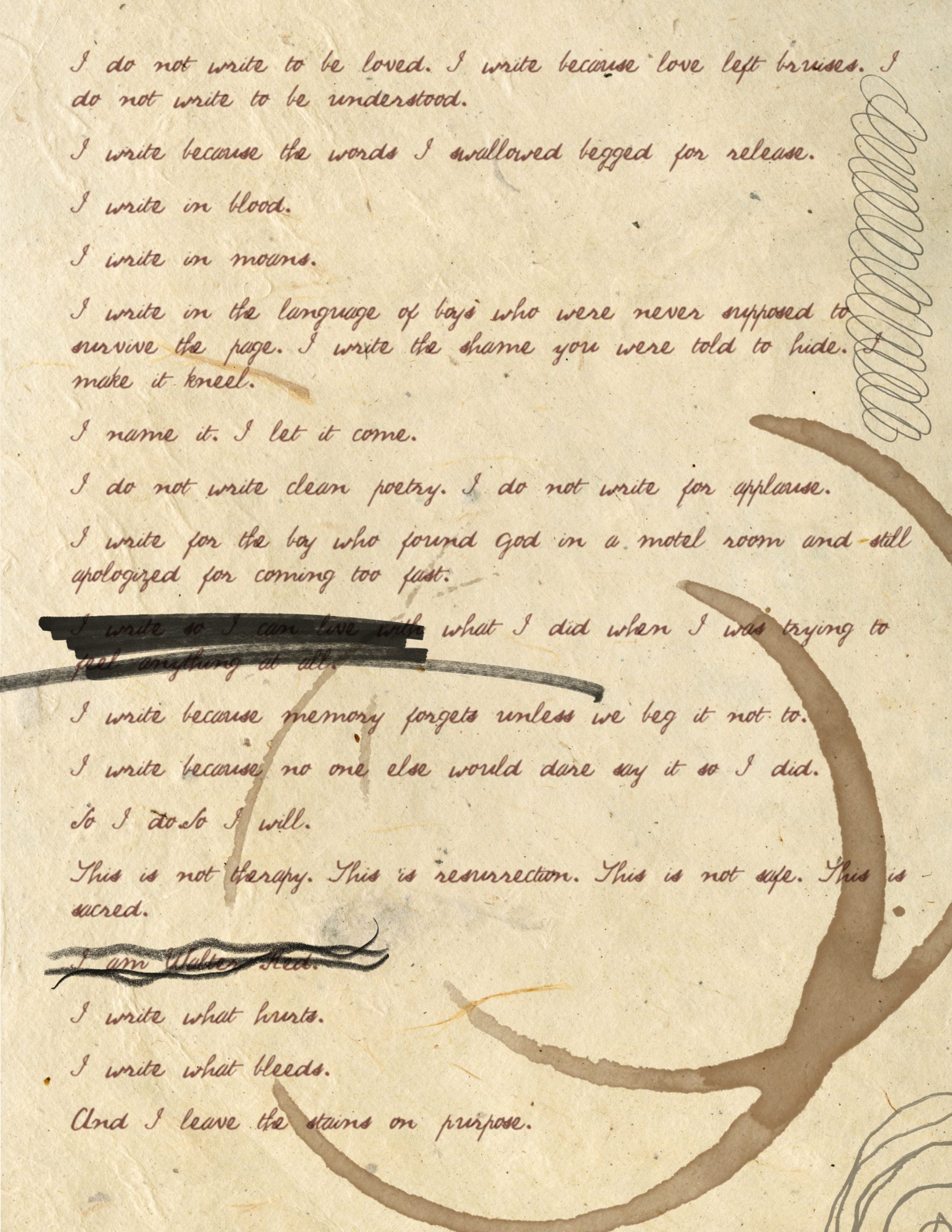
The creative media surrounding the case performs a different function. The poems, letters, software artifacts, closure forms, and symbolic filings do not merely document the relationship. They metabolize it. The case file speaks in forensic language because it needs precision. The creative artifacts speak in ritual language because precision is not enough. A chart can show a pattern; it cannot hold the ache of being warm in someone’s presence and abandoned by their absence. The archive splits the labor: analysis names the mechanism, art carries the residue.
The closure file is therefore not a joke, though it uses bureaucratic absurdity as armor. Its administrative tone allows the vulnerable party to do what the relationship did not allow him to do cleanly: terminate access, revoke implied privileges, preserve tenderness without permitting reactivation, and mark the matter closed without requiring the other party’s agreement. This is emotionally intelligent in the least romantic costume possible. The Department of Feelings, ridiculous little office that it is, performs a necessary function: it separates memory from permission.
That separation is the final act of repair. The case does not require the vulnerable party to declare that nothing was real. In fact, doing so would be another distortion. The warmth was real. The care was real. The longing was real. The moments of safety were real. The failure is that reality was not matched by responsibility. Preserving tenderness without reopening access is one of the hardest tasks after avoidant betrayal. It means refusing both extremes: not turning the beloved figure into a demon, and not turning the memory of tenderness into a legal claim on the future.
The title, “Choking on Pride,” points to the returning party’s central limitation as the record presents it: not simple indifference, but the inability or unwillingness to swallow enough pride to say the plain thing. The plain thing would have been: “I returned because I wanted access to you, but I could not or would not meet the structure that access required.” The plain thing would have been: “I liked being loved by you more than I liked being accountable to you.” The plain thing would have been: “I kept the door open because closing it would make me feel cruel, but keeping it open hurt you more.”
Instead, the record shows a recurring preference for softened exits, conditional language, philosophical reframing, and contextual self-defense. That is ego-preservation. It protects the self-concept of the person withdrawing. It lets him remain, in his own mind, caring, overwhelmed, misunderstood, and reasonable. Perhaps he was all of those things in part. But care that cannot tolerate accountability becomes self-protection with a kind face. And self-protection, when practiced by the person with more relational power, can become betrayal without ever needing to raise its voice.
The vulnerable party’s own responsibility is also present, but it is not the responsibility falsely assigned to him. His error was not caring too much. His error was continuing to treat potential as evidence. He mistook the returning party’s warmth for capacity, and capacity for willingness. He treated moments of presence as proof that consistency was possible. In one sense, he was correct: consistency was possible. The record contains enough examples of care to prove that the returning party could show up when he chose to. But possibility is not commitment. A person’s best moments are not a contract. They are data, and sometimes the data says only this: he could, but he did not.
That sentence is brutal because it removes the last refuge of hope. If someone cannot show up, the fantasy can remain merciful: maybe under different circumstances. If someone can show up but repeatedly does not, the wound becomes clearer. The issue is no longer capacity. It is priority, tolerance, courage, or desire. The vulnerable party spent much of the record trying to solve the wrong problem. He tried to become easier to choose. The actual problem was that the other person wanted the benefits of choosing without the burden of being chosen back.
This case therefore stands as a study in structural betrayal. Not betrayal as a single dramatic violation, but betrayal as repeated re-entry without repair. Betrayal as warmth without reliability. Betrayal as future language without future labor. Betrayal as the preservation of one person’s flexibility through the consumption of another person’s nervous system. Betrayal as the refusal to give a clean no because a clean no would damage the self-image of the person refusing.
The closure does not come from mutual understanding. It comes from the record becoming sufficient. That is a colder form of closure, but sometimes colder forms are the only ones that do not rot. The vulnerable party does not need the returning party to validate the pattern for the pattern to have existed. He does not need a confession to establish breach. He does not need a final conversation in which everything is finally seen, named, and held correctly. That fantasy belongs to the open loop. Closure begins when the injured person stops outsourcing reality to the person who benefited from ambiguity.
In the end, the relationship failed for a painfully ordinary reason dressed in unusually ornate documentation: one person wanted connection without containment, and the other could not survive connection without it. The tragedy is that both may have cared. The verdict is that care was not enough. Care without structure became intermittent reinforcement. Warmth without accountability became destabilization. Flexibility without mutuality became asymmetry. Pride without truth became avoidant betrayal.
The record stands not as revenge, but as refusal. Refusal to let silence rewrite the sequence. Refusal to let tenderness excuse structural harm. Refusal to let professional fluency, soft language, stress, charm, or ambiguity convert a breach into a misunderstanding. Refusal to keep calling instability “taking it slow.”
What remains is not an appeal. It is an archive.
The door is not waiting.
The file is closed.