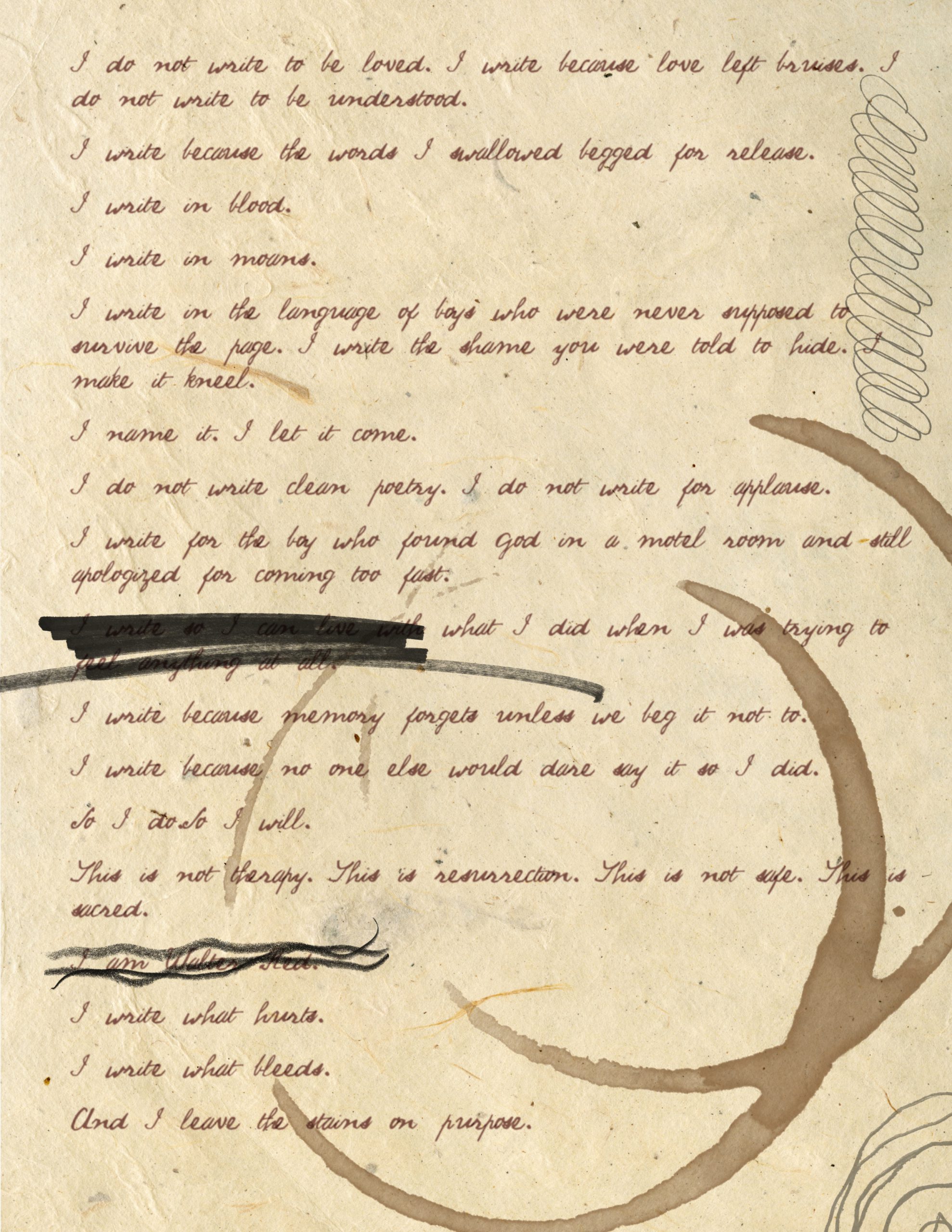
Author’s Note
This collection is a personal and documentary account of a relationship and its aftermath. It draws on preserved correspondence, contemporaneous records, later recollections, creative writing, and third-party accounts. These sources carry different evidentiary weight; the essays distinguish them where material and identify uncertainties that affect the interpretation.
Names and identifying details have been omitted or generalized to preserve privacy. Quotations represent the available source material; a statement’s inclusion establishes that it was made, rather than independently confirming everything it asserts. Recollection and interpretation are presented as such.
The collection describes conduct, sequence, and experienced consequences. It does not claim access to another person’s private motives or offer a clinical diagnosis. Psychological concepts serve as interpretive frameworks, not findings about any individual.
The account reflects the materials available at the time of revision. It remains open to correction where further reliable evidence warrants it.
Its purpose is to preserve a considered account of what occurred, including the care, the harm, and the limits of what can be known.
The Museum of Failure
Choking on Pride and the final attempt at repair
A friendship can end while the evidence of care remains intact. That is the difficulty this account has to carry. The person who became unreliable had also brought food, made room, returned after silence, received a private offering with tenderness, and helped another person feel less alone. The damage did not cancel those acts. Those acts did not prevent the damage. The final rebuilding attempt failed in the space between them: renewed connection repeatedly created expectations that the relationship’s ordinary practices could not sustain.
This essay follows a bond that began in October 2023 and ended in June 2026, with the evidentiary review continuing through October 4. It uses Participant A and Participant B throughout; the person who witnessed the final conflict is called the witness. The point is to understand the sequence and its consequences, rather than to identify the people or turn private feeling into a diagnosis. The controlling question is what the relationship actually became after each return, especially the last one. Reconnection happened. The record does not support treating the final period as a sustained, functioning process of repair.
The account draws on the supplied draft, preserved messages, Participant A’s recollections and creative writing, and the surviving witness correspondence. Clinical Reframing of Choking on Pride and Betrayal as Relational Rupture supply analytical frameworks. They are companions to the evidence, not additional witnesses to the events. Repetition of a claim across an essay, case study, and research companion does not turn one source into three independent confirmations.
The distinctions matter throughout. A dated message establishes that someone said something, not that every assertion inside it was true. A recollection preserves a remembered experience, including its uncertainties. Corroboration extends only as far as another person’s own observation. An inference explains a pattern without becoming proof of motive. The archive is substantially richer from Participant A’s side, and its preservation and selection are part of its limits. Participant B’s private beliefs, reasons, and capacity cannot be reconstructed from silence or supplied by psychological vocabulary. Even the better-supported conclusions remain conclusions about conduct, sequence, and effect.
The Care That Made Return Possible
The connection began under limited terms. It acquired emotional weight through repeated meetings, private routines, shared humor, affectionate exchanges, and the ordinary familiarity that makes another person part of a life. In January 2024, Participant B stated that a more formal or romantic relationship was unavailable. That ceiling belongs in the account without qualification. Affection did not invalidate it, and Participant A’s attachment did not create an entitlement to its removal.
Yet the relationship continued to include forms of closeness that Participant A experienced as exceptional. Shared time, sleepovers, warmth, and repeated returns gave the bond a lived meaning that did not fit neatly inside its initial frame. The problem was not that conduct secretly revoked an explicit limit. It was that the participants did not establish a sufficiently shared account of what the continuing closeness did mean. A ceiling on romance could be clear while the obligations of the friendship beneath it remained unsettled.
After Participant A was injured in an accident in March 2024, Participant B visited, brought food, and offered reassurance. These were concrete acts. They make it impossible to write an honest account in which Participant B was simply absent, indifferent, or incapable of care. They also explain why later assurances carried weight. Participant A had seen support become action. Hope was attached to a remembered person who had shown up, rather than to a personality invented to make the waiting bearable.
That earlier care is a benchmark, though it has to be used carefully. Showing up during one crisis does not prove unlimited capacity during every later period. A person’s circumstances can change; exceptional responsiveness does not establish that all subsequent failures were deliberate choices. What the benchmark does establish is why trust was plausible. Participant A’s belief that this bond could contain practical tenderness had an evidentiary basis.
The first formal ending came in May 2024. Participant B withdrew in writing, citing a need to pull back and focus elsewhere. Participant A responded with grief and gratitude. The loss was painful, but it had a recognizable boundary. There was a goodbye to receive. Compared with the later disappearances, this ending left less work to be performed by the person being left: it did not require constant interpretation of whether the relationship still existed.
A clear ending can wound without keeping the wound administratively open. The later history would make that distinction increasingly important.
The First Return And The Unfinished Goodbye
Participant B returned in August 2024. After months of silence, renewed contact reopened the possibility of friendship. Participant A’s later account remembers a private meeting in which welcome and closeness suggested that the bond had survived its interruption. The emotional significance of that scene belongs to recollection; the broader sequence of resumed contact belongs to the preserved record. Together, they explain why return felt like more than a message arriving.
During a subsequent medical crisis involving Participant A’s partner, Participant B offered supportive messages and some in-person comfort. The support was meaningful, but it did not consistently become the practical presence Participant A remembered from the earlier accident. That difference need not be converted into a moral ranking of crises. Its importance lies in the emerging variability: care could be available and then difficult to predict, relieving distress at one point without establishing confidence about the next.
The autumn contained ordinary friendship as well as crisis response. There were meals, errands, cabin projects, gifts, coffee, writing, and check-ins. Participant A contributed time and practical help and adapted around Participant B’s schedule. Participant B offered reassurance that the friendship would continue. These details matter because the later silence followed participation and assurance, rather than a relationship that had remained wholly distant.
When a planned weekend changed in November, Participant A reacted, apologized, and waited. Follow-up weakened. A request for clarity did not produce a substantive resolution. The friendship disappeared by degrees instead of ending through another direct goodbye. Participant A was left to work out whether the silence meant a pause, a withdrawal, an overburdened friend, or an ending that had not been named.
Here the loss acquired a second task. Grief usually asks what to do with someone’s absence. This absence also asked whether grief was premature. If contact might resume, mourning could feel disloyal to possibility. If the friendship was over, waiting could become its own injury. The research companion’s discussion of ambiguous loss helps name that predicament, but it does not diagnose either participant. It gives language to a practical uncertainty: the person remained emotionally present while the relationship became operationally unavailable.
The Return That Seemed To Mean Repair
In January 2025, Participant B returned again, saying the relationship mattered too much to resolve through text alone. The words suggested that the earlier rupture would now be addressed with greater care. Meaningful time together followed. In the associated creative recollection, a cabin weekend is held through oil lamps, an imperfect breakfast, a loft, shared quiet, and the feeling that grief could be present without being mocked or rejected.
Those images are not measurements of relational reliability. They are part of why reliability was still hoped for. Participant A later made a framed piece connected to the memory. Participant B appeared moved and kept it visible. The account can preserve the offering and its reception without deciding that the object proved a future commitment. A gift can be sincerely received in a relationship that remains unable to hold its consequences.
On March 18, 2025, Participant B joined Participant A at the hospital during Participant A’s partner’s cardiac ablation. The messages record arrival coordination, Participant A’s thanks afterward, and Participant B’s acknowledgment of being there. This was a concrete act of care, and it belongs in the account alongside the ruptures.
In March, Participant A sent a long private letter about the bond’s emotional meaning, earlier wounds, and the distress caused by repeated uncertainty. Participant B agreed to discuss it. According to Participant A’s account, the full letter had not been read before the attempted conversation, and another person was nearby. Participant A experienced the setting as insufficiently private. The substantive discussion did not occur in the form anticipated, and the connection ended by text at the end of that month.
The messages place the visit on March 30. Participant A’s follow-up sought a private, distraction-free discussion the next day. On March 31, Participant B instead sent a written response ending the connection. These dates establish the sequence without explaining what Participant B privately felt about the letter.
The injury was not a failure to return the same feelings. Reciprocity of affection could not be compelled by the depth of a disclosure. What Participant A had hoped for was a response that could hold the disclosure without leaving its central questions scattered between an inadequate setting and a remote ending. A refusal could have been a response. A limit could have been a response. Participant A’s account describes a failure of containment: the material was received into the relationship, but the relationship did not provide a sufficiently direct and settled way to handle it.
That conclusion is about the interaction and Participant A’s experience of it. It is not a finding about Participant B’s clinical competence, attachment classification, or capacity for empathy. The research language is useful only while it remains smaller than the evidence.
What The Archive Was Trying To Preserve
During the ensuing silence, Participant A wrote, worked, made art, and assembled records. The archive grew around dates, letters, messages, essays, and remembered scenes. It attempted to keep the sequence available when the emotional experience made it difficult to hold tenderness and injury together.
That is a plausible purpose of the documentation, and the documents themselves show sustained efforts at interpretation. They do not prove that writing healed Participant A or protected every memory from error. An archive can stabilize a date while preserving a mistaken inference beside it. It can contain a correct quotation in a paragraph whose conclusion goes too far. The work of making a record sufficient therefore includes correction, not merely accumulation.
The title The Museum of Failure carries that ambivalence. A museum preserves what time might otherwise flatten. It also selects, labels, arranges, and invites a viewer to understand the objects through a particular route. This account cannot pretend that its arrangement is neutral simply because it contains receipts. It can make the arrangement accountable: identify which objects are messages, which are memories, which are another person’s testimony, and which are interpretations made afterward.
The good memories belong in that museum. Removing them would make the case simpler and less true. Keeping only the good would produce the opposite distortion. Participant A needed an account capable of saying that a person had been kind and that the continuing relationship had become damaging. Neither statement made the other impossible.
This was the unfinished history into which the final return arrived.
The Final Attempt And Its Promised Direction
Participant B reopened contact in November 2025. Participant A was surprised and emotionally unsteady, but willing to meet. The first encounters were difficult. Participant A acknowledged intensity and asked how to be a better friend. The willingness to begin again was not evidence that earlier injury had vanished. It was another decision to test whether the relationship could become different.
Participant A later described this last rebuilding period as roughly nine months. That description captures how the attempt was experienced and discussed, but the dated record needs a correction: the return documented on November 2, 2025, and the termination on June 25, 2026, are just under eight months apart. This essay preserves the “nine-month attempt” as retrospective language, not an exact calendar calculation. Its argument does not depend on adding a month. It depends on the relation between what was proposed and what occurred across the period actually documented.
The Thanksgiving exchange gives that argument a baseline. On November 27, Participant A raised the possibility of the cabin without demanding an immediate date. Participant B proposed building up to an overnight as a “near-term goal.” Participant A asked for clarification instead of assuming what that meant: would there be an encounter or two first, or was the cabin itself the next step?
Participant B then described spending more time together at their homes or elsewhere, getting reacquainted, and building toward overnights and the cabin. Participant A agreed to the slower pace, offered hospitality, and said they were settled enough to begin planning. Participant B acknowledged the readiness. The exchange did not guarantee an overnight, promise romance, or eliminate the need for continuing consent. It did describe a direction for renewed friendship.
That direction matters more than a universal definition of “near-term.” There is no fixed deadline by which all friendships must repair, and a generic estimate cannot establish one for these participants. The relevant standard came from the participants’ own exchange: more shared time, renewed familiarity, and gradual movement toward experiences they had named. Circumstances could interrupt that route or make it unavailable. In that event, the route could have been explicitly revised.
Participant A’s later protest about six visits, nine visits, or visits spread across months was therefore not simply arithmetic. Those counts appear in retrospective descriptions with differing scopes; this essay does not turn them into a verified, exhaustive attendance ledger. Nor would any particular number independently establish that a friendship was inadequate. Some friends meet infrequently and remain dependable. The question was what these particular meetings did inside a relationship reopened under the language of rebuilding.
Participant A had agreed to gradual movement. The recurring difficulty was determining whether movement was occurring, whether the destination remained shared, and what would happen when the next plan failed. Slow progression can include pauses. A succession of pauses does not prove progression merely because time continues to pass.
Pace Is A Description Of Movement
“Taking things slowly” can be a reasonable limit. It can protect both people from rushing into a familiar arrangement before its problems are understood. But pace describes the rate of movement; it cannot settle the question of direction. The distinction became the procedural center of this final attempt.
Meetings did occur. Some were long, warm, and significant. Gifts were exchanged, lunches arranged, and a substantial March conversation included trust, personal context, and offers of practical help. These are positive facts. They prevent the essay from claiming that the entire period was empty. They do not, by themselves, establish that the conditions producing earlier ruptures had changed.
Alongside them, the record describes delayed planning, cancellations, missed follow-through, repeated confirmation, and arrangements left indefinite. Participant B cited work, stress, moving, crises, and competing demands. Those circumstances may have been real and substantial. The essay has no basis to declare them excuses invented to conceal an intention. It can ask what provision the renewed friendship made for their foreseeable effects.
A repair process need not eliminate a demanding life. It needs a way to accommodate it that both people can understand. A cancelled plan can be followed by a replacement date. A period of low capacity can be named. A goal that has become unrealistic can be withdrawn. These are examples of the kind of operational clarity Participant A was seeking, not claims that the participants had agreed to every one of them.
Instead, Participant A repeatedly had to decide whether to ask again, whether another question would count as pressure, whether silence required patience, and whether a good meeting meant the earlier difficulty had finally been resolved. The next encounter could soothe the distress without answering those questions. In that situation, a successful evening became emotionally important while remaining structurally inconclusive.
The corrected home visits make the account more precise. Participant A visited Participant B’s new home twice: May 18 and June 23. The first visit included dinner; the second ended before dinner could take place. Any version claiming that Participant A never entered the new home is wrong. The correction does not erase the broader concern. It replaces an inaccurate absence claim with a better question: after access was actually granted, did the relationship become more predictable, more clearly defined, or better able to manage disagreement?
The failure was not total exclusion. It was the repeated inability to make inclusion dependable. That is a more complicated account, and a stronger one.
The Administration Of Hope
Much of the labor in this period was easy to mistake for feeling alone. Participant A waited, checked dates, softened requests, made availability explicit, sought confirmation, and tried to understand the terms. These are ordinary administrative tasks until they become the main way a relationship is kept alive.
Participant B held greater practical control over re-entry, access, timing, and exit. Participant A was not without agency: they accepted returns, made requests, protested, and could decide to withdraw. But choosing whether to remain available is different from being able to make the other person’s availability intelligible. The distribution of control left Participant A doing more of the work of translating possibility into something that could be planned around.
Hope was administered through these small decisions. An invitation made a future imaginable. A postponement left the future unsettled. Reassurance kept it available without necessarily putting it on a calendar. A warm meeting supplied new reason to wait. The pattern could consume attention without anyone consciously designing it to do so.
The research companions call this predictive uncertainty. In ordinary terms, Participant A could not reliably tell which signals would lead to contact and which would precede withdrawal. Delays and tonal shifts acquired significance through history. A person who had already experienced return followed by disappearance might become alert to an unanswered message for reasons larger than that message itself.
That explanation does not make every alarm accurate. Participant A sometimes pursued clarification intensely, overexplained, or read the present through earlier wounds. Their own later correspondence acknowledges those tendencies. Understanding how a reaction developed is not a declaration that it was proportionate or harmless. It permits a more useful question than whether Participant A was simply too sensitive: what part of the alarm belonged to the current event, what part belonged to the accumulated history, and what response might have reduced the uncertainty?
The companions’ cautious discussion of intermittent reinforcement also belongs here. As an analogy, it helps explain why unpredictable warmth can sustain renewed attention and repeated hope. It does not prove a deliberate reward schedule, addiction, or manipulation. This relationship was not a laboratory, and neither participant can be reduced to a mechanism. The useful observation is that occasional relief may keep someone invested even when dependable continuity remains absent.
For Participant A, this created a difficult accounting problem. There was enough evidence of care to make dismissal dishonest and enough evidence of instability to make reliance increasingly costly. The question was no longer whether warmth could occur. It was whether warmth had become a trustworthy predictor of what came next.
The Friendship With Two Models And No Settled Terms
In December, Participant A asked whether Participant B was available for an ongoing, clearly defined connection. Participant B understood the question as premature in a gradual return and resisted the requested language of boundaries. The disagreement exposed different expectations about what structure was for. Participant A was seeking predictability; Participant B defended a more limited or flexible offering.
Different expectations can be a legitimate incompatibility. The difficulty was that the limited offering did not acquire sufficiently concrete terms. If one person is offered less contact, fewer commitments, or a more tentative friendship, the meaning of “less” still matters. Without it, consent to continue can become consent to discover the terms only when a request exceeds them.
In April, Participant A delivered an accountability packet asking for direct communication, follow-through, reliable planning, and clarity. Participant B’s April 10 response acknowledged hurt and impact, described significant pressure, and said, “I cannot presently deliver on what you need.” It also retained the possibility of later contact when circumstances changed.
The acknowledgment deserves to remain visible. It was not no acknowledgment at all. The limitation also deserves to be taken seriously. A person can recognize harm and still lack the capacity to participate differently. The unresolved issue was what the conditional future meant for Participant A. The message stepped away from present participation while preserving a possible later return, after earlier returns had already renewed the same expectation.
On April 27, Participant B framed the conflict as Participant A wanting A while Participant B could offer only B, and said Participant A could choose not to participate. That formulation named mismatch, but it did not make B sufficiently operational. The preserved exchange does not establish a shared alternative model with clear expectations that Participant A simply refused. It shows Participant B asserting a reduced offering and Participant A disputing the absence of usable terms.
It would go too far to call that formulation a knowingly fabricated alibi. The record cannot establish that purpose. Its observable limitation is enough: it moved the argument toward differing needs without resolving the repeated uncertainty over what could actually be expected. Participant A’s request for a definition remained materially unanswered.
A person may decline a friendship. A person may offer a modest one. But the words “you can choose” carry practical force only when the available choice is sufficiently legible. Participant A was trying to distinguish a limited friendship from an indefinitely deferred one. The archive shows how often that distinction remained unsettled.
Pride Without A Diagnosis
The phrase Choking on Pride names an interpretation, not an established interior state. The strongest version of the argument does not say Participant B secretly preferred being admired to being accountable, or knew exactly how much distress ambiguity caused. Those claims would require evidence the archive does not possess.
What it does preserve is a communicative pattern. Requests about conduct were often met with explanations of stress, limited capacity, felt criticism, or incompatible needs. In April there was acknowledgment before the explanation. In June there was a severe judgment of Participant A’s conduct. Across these exchanges, the factual question of what had been proposed, performed, changed, or omitted could become entangled with the question of whether Participant B was being fairly understood.
Ego-preservation is useful here as a reading of how a response functions. A statement can protect a speaker’s position by emphasizing intention and context while leaving particular actions insufficiently addressed. That effect does not prove conscious evasion. It does not establish that the context was false. A person can be stressed and have caused harm; a person can feel accused and still have an unanswered question to address.
Accountability would have required enough specificity for both participants to examine the same sequence. Which expectations had been invited? Which commitments could still be sustained? What should happen after a missed plan? What part of a conflict belonged to each person? Those questions concern practices, not an admission that someone is fundamentally bad.
Participant A faced an equivalent demand. They could not make every reaction righteous by placing it after a history of disappointment. Tone, pressure, and defensive withdrawal could injure Participant B regardless of their origin. The archive’s fairness depends on preserving that responsibility. Its force depends on declining to make it the entire explanation.
Pride, in this reading, is the difficulty of letting an account become specific enough to include one’s own contribution. The essay can examine that difficulty in the exchanges. It cannot announce what Participant B was protecting internally, why they protected it, or whether the same pattern governed every other relationship.
The Last Weeks Were Still A Friendship
Contact resumed in May. On May 8, Participant B reassured Participant A that they were okay and needed to do what they had said they would do. The words matter because they reopened an expectation of shared action after the April withdrawal. They did not establish what all that action would entail.
On May 18, Participant A went to Participant B’s new home for dinner. Another person’s presence limited the private conversation Participant A had anticipated, according to the draft’s account. Participant A’s message afterward said they had enjoyed the evening even if it had not fully shown and acknowledged difficulty with their place in the order of things. That combination is characteristic of the final period: a good experience, an unresolved question, and an effort to absorb the question without making it another conflict.
On June 4, Participant B had dinner at Participant A’s home. Gratitude followed, and Participant B praised the food. The June 5 messages show Participant A offering to bring the leftovers to Participant B’s workplace, alongside a request for private conversation. They establish an offer and a meeting arrangement, not completed delivery. Participant A corrects the later account: the leftovers were ready on the counter but were accidentally left behind when A rushed out; A realized this only at the hotel. That detail is Participant A’s recollection, rather than a fact independently confirmed by the planning texts. The request for clarity was therefore not created after the final rupture to make an otherwise settled arrangement look defective. It existed while meals, hospitality, and continuing contact were still occurring.
The birthday sequence began before the final gathering and became unsettled again after the June 4 dinner. On June 10, Participant A asked about the times or dates Participant B had mentioned for something before Monday. After another request on June 11, Participant B described a Salem trip and proposed Wednesday or Thursday. Asked whether that meant no Monday meeting, Participant B said yes, apart from a shorter coffee date. Participant A replied, “Got it. Happy birthday to me.” Participant B then said the weeks had been confused and insisted that attendance had always been intended. The texts establish this reversal and its stated explanation; they do not establish deliberate disregard. Participant B did attend on June 15. Participant A experienced the attendance as meaningful. Another dinner at Participant B’s home was arranged afterward. A concrete date could feel especially reassuring in a relationship where so much planning had remained uncertain.
There was also an uncompleted plan to collect leftover baked goods. The June 16 exchange was followed by no further message in the produced thread until Monday, June 22, when Participant B apologized for missing the baked goods and confirmed dinner. Neither the June 15 invitation nor the June 22 confirmation disclosed prospective other guests. The June 23 arrival instructions did not supply that notice either. Participant A’s June 22 reply, “See you guys then,” received no clarification. A later explanation identifies it as a probe, informed by the earlier visit when another person was present. The plural wording records suspicion or anticipation; it does not constitute notice from the host. Within the produced planning exchange, no text disclosed or confirmed the additional guest arrangement. This is a finding about the inspected record, not a certification that every possible conversation survives.
These weeks prevent a misleading account of total estrangement before the end. The friendship was still being enacted. Both participants were entering homes, giving and receiving hospitality, and making plans. That reality made the final termination more painful. It also made the distinction between enacted connection and accomplished repair unavoidable.
What it does preserve is a communicative pattern. Requests about conduct were often met with explanations of stress, limited capacity, felt criticism, or incompatible needs. In April there was acknowledgment before the explanation. In June there was a severe judgment of Participant A’s conduct. Across these exchanges, the factual question of what had been proposed, performed, changed, or omitted could become entangled with the question of whether Participant B was being fairly understood.
Ego-preservation is useful here as a reading of how a response functions. A statement can protect a speaker’s position by emphasizing intention and context while leaving particular actions insufficiently addressed. That effect does not prove conscious evasion. It does not establish that the context was false. A person can be stressed and have caused harm; a person can feel accused and still have an unanswered question to address.
Accountability would have required enough specificity for both participants to examine the same sequence. Which expectations had been invited? Which commitments could still be sustained? What should happen after a missed plan? What part of a conflict belonged to each person? Those questions concern practices, not an admission that someone is fundamentally bad.
Participant A faced an equivalent demand. They could not make every reaction righteous by placing it after a history of disappointment. Tone, pressure, and defensive withdrawal could injure Participant B regardless of their origin. The archive’s fairness depends on preserving that responsibility. Its force depends on declining to make it the entire explanation.
Pride, in this reading, is the difficulty of letting an account become specific enough to include one’s own contribution. The essay can examine that difficulty in the exchanges. It cannot announce what Participant B was protecting internally, why they protected it, or whether the same pattern governed every other relationship.
The Room On June 23
Participant A’s immediate explanation and later recollection describe arriving after assisting during a frightening medical emergency involving someone else, walking in heat, and carrying the residue of a difficult week. The later witness correspondence clarifies that the feared medical event was not the eventual explanation. The account therefore treats it as an apparent emergency at the time, without inventing a confirmed diagnosis.
Participant A arrived tense and flat. They acknowledge it. Their later recollection includes sarcastic and defensive remarks, not merely a quiet person unfairly punished for having feelings. Participant B’s termination message says they asked whether things were all right and offered to reschedule. Participant A’s account also includes that offer. The apparent attempt to make the evening easier belongs in the reconstruction.
Its meaning was contested. From outside the history, rescheduling could be a reasonable accommodation to an overloaded guest. Participant A says it sounded, from inside the history, like surrendering a concrete evening and returning to indefinite waiting. That interpretation explains the refusal; it does not prove the offer was insincere. The offer also preceded full disclosure of the social arrangement, according to Participant A’s account. It could not settle a choice about circumstances Participant A did not yet understand.
The witness then appeared. Participant A had not been told this person would be there. In the later recollection, Participant A was cordial to the witness but curt with Participant B. The distinction matters. It does not establish faultlessness, but it narrows a picture of generalized hostility toward everyone in the room.
Participant A said they were uncomfortable and that notice about another guest would have been basic courtesy. Their detailed recollection describes preparing to leave, the witness offering to leave instead, Participant B refusing that offer, and Participant B ordering Participant A out. That account also recalls utensils being thrown into a sink and a shouted command. Those details remain Participant A’s recollection; the witness’s later description independently supports an escalation by Participant B and an attempt to intervene, without confirming every physical detail or exact phrase.
The available timing supports a very brief encounter, commonly described in the archive as ten to fifteen minutes. It does not supply a perfectly synchronized transcript. Participant A’s later reconstruction contains timestamps and remembered order that do not align neatly in every detail. That limits precision, not the broader sequence: arrival, discovery of undisclosed company, objection, escalation, departure, and an immediate explanatory message.
No secret plan is needed to understand why the room failed. Participant A’s tension could hurt Participant B. Participant B’s lack of disclosure could hurt Participant A. The witness could recognize the tension and try to reduce it. The exchange could then escalate beyond what either participant had expected. The supported objection concerns the conditions of participation and the response to discomfort, not a proved ambush.
The dinner did not have to carry all the preceding history to become difficult. Yet the history was already in the room through what each participant expected the other’s words to mean. The rupture made the arrangement’s fragility visible. It did not create that fragility from nothing.
The Verdict And The Reply
Participant A sent an explanation that night, described the apparent emergency, acknowledged a heightened state, and apologized for the ruined dinner. The message also included anticipatory defeat and interpretations of the relationship. It was not a detached incident report. It shows a person trying to explain and already expecting rejection.
After silence, Participant A sent another message anticipating an ending and offering to talk if that expectation was wrong. On June 25, Participant B ended the friendship. The message described Participant A’s arrival as carrying a bad attitude, stated that personal difficulties did not excuse mistreatment, called the conduct rude, disrespectful, and abusive, and rejected future rekindling.
Participant B had the right to end contact. That right does not make every explanation of the ending independently established. The message records an accusation and Participant B’s appraisal. It does not identify a distinct act sufficient to resolve the disputed escalation from tense or hostile conduct to the strongest label. It also does not address the undisclosed guest, the witness’s reported attempt to intervene, or Participant B’s contribution to the escalation described by Participant A and later partly corroborated by the witness.
Those omissions do not prove that Participant B knowingly lied. A termination message is not obliged to be a comprehensive history. But when it assigns sole responsibility for a multiyear friendship’s collapse, its narrowness matters. The archive cannot receive that assignment as a finding simply because it arrives in definitive language.
Participant A’s same-day reply accepted the ending and took responsibility for the impact of a tense presence. It rejected the characterization of abuse and sole responsibility for the breakdown. This was a distinction between respecting withdrawal and endorsing the account attached to it. Participant A could comply with the end of access without surrendering the right to describe the sequence differently.
The last dinner was therefore followed by another conflict, this time about what could be said to have happened. The relationship was over. The explanation was still disputed.
The Witness And The Limits Of Corroboration
Participant A contacted the witness to apologize. The next-day reply reassured Participant A that they were “totally fine.” That was a contemporaneous response from someone present for the critical exchange, and it materially complicates the idea of a unanimously perceived abusive incident.
It is also a brief reassurance. It is not a full transcript, a formal assessment, or proof that Participant A behaved impeccably. The witness had a connection with Participant B and cannot simply be certified neutral because they were a third person. Their value comes from presence and the content of what they reported, not from an assumed freedom from every allegiance or interpretive bias.
The witness later gave a more detailed August recollection. It described Participant A as short with Participant B, cordial toward the witness, and upset about not having been warned. It recalled Participant B escalating when that omission was raised and the witness trying to intervene. This later account is more detailed but more distant in time. The June reassurance and August recollection are two statements from the same source, not two independent witnesses.
The August account also said the witness had believed Participant A was already informed. Participant A’s preserved account and the absence of disclosure in the planning exchange point the other way. The strongest supported finding is unequal information: the witness expected informed attendance, Participant A arrived without the relevant notice, and Participant B was central to the arrangements.
The witness’s June 24 correspondence also reports an earlier attempt to attend the birthday: “I did try to get invited to your birthday but was shut down.” That report places the witness’s interest before the gathering, although it supplies neither the date of the request nor a direct record of the refusal. A later June 23 Evidence Findings Memorandum records the birthday attendee’s recollection that Participant B asked whether the birthday attendee would attend and indicated that B’s own attendance depended on the birthday attendee being there. The memorandum is a secondary account of the birthday attendee’s testimony, not the original exchange. The June 15 text does independently show Participant A telling B that most guests were departing and the birthday attendee remained. It does not independently establish the condition described by the birthday attendee. Nor do the inspected sources establish that the witness’s invitation attempt went through the birthday attendee; that route remains a reported detail requiring its original support. Read alongside the June 4 dinner and June 11 birthday reversal, these records restore the changing attendance arrangements without deciding whether the stated confusion was sincere or strategic. They cannot prove a plan to exclude, recruit, or manipulate anyone.
Participant A declined offers to mediate or contact Participant B. That refusal is significant because it limits a claim that the witness exchange was recruited to pressure Participant B through another person. It does not make Participant A’s questions emotionally disinterested. It shows that asking what a witness observed can be distinct from appointing a witness to reopen a terminated relationship.
The later evidence changed the account by making some details more secure and some larger claims less sustainable. A careful essay has to accept both effects.
When Testimony Becomes Explanation
The provenance problem arose within the August recollection itself. After describing the room, the witness moved into a psychological explanation involving repeated accusations of bad intent. The witness explicitly linked that formulation to something Participant B was mentioning. The wording matters because it presents the explanation as connected to Participant B, rather than confined to the witness’s own observation.
That sentence suggests an information source beyond the witness’s observation of one brief encounter. It does not identify the source with enough precision to authenticate the longer claim. Was the witness relaying a prior conversation, interpreting something Participant B had said, combining Participant A’s materials with their own experience, or using shorthand that meant something else? The surviving exchange does not resolve the alternatives.
Participant A asked what had been said, when it had been said, and which examples supported the claim of a repeated pattern. Those were provenance questions. They sought to distinguish direct observation from a transmitted account and interpretation. The questions remained unanswered in the available record.
This distinction is decisive. A witness can accurately recall one scene and still exceed their evidentiary reach when explaining a multiyear relationship. Their direct observation does not lend automatic authority to a broader characterization that came from another source. Equally, an unresolved source chain does not prove that Participant B appointed the witness as a spokesperson, scripted the explanation, or organized a campaign against Participant A.
Participant A expressly rejected the theory that June 23 had been maliciously staged. The continuing complaint was narrower: important information had not been supplied beforehand; the ensuing account did not include all material circumstances; and a later explanation referred to a longer pattern without disclosing its basis. These claims do not become weak merely because they stop short of conspiracy. Their restraint makes them assessable.
Later correspondence introduced further personal and intimate overtures that were separate from the evidentiary questions. Those details do not need to become spectacle in this essay. Their relevant effect was to complicate the channel through which clarification was being sought. Participant A declined mixing intimacy with the dispute and asked for any proposed conversation to become concrete. That documents a boundary. It does not establish another person’s predatory motive or retroactively discredit every earlier observation.
Repeated offers of a fuller conversation were not completed. Availability was provided without a settled meeting following. As of October 4, the central questions about the information behind the witness’s longer characterization remained unresolved. The familiar administrative problem had appeared in a new channel: a possible conversation continued to exist without becoming an actual one.
What July Added
In July, Participant A learned that the account of the friendship had continued beyond the friendship itself. A person who had recently visited Participant B reported that B had discouraged contact with A. The visitor’s recollection did not preserve the exact words or full context, and their brief confirmation came in response to A’s question. It remains a reported conversation, not a verbatim statement from B. Even within that limit, it matters: A was receiving no direct explanation while learning of an adverse account elsewhere.
The same visitor described difficulties with planning, competing company, and changes in warmth during their own time with B. They also reported B advising them how to respond to another acquaintance. These details concern the visitor’s experience. They do not make the visitor a witness to June 23, or establish that different relationships followed one deliberate design. Their account included renewed invitations as well as coldness, and that complication belongs beside the similarities.
July therefore added context rather than a final verdict. The difficulty was no longer confined to a disagreement between two people about one evening. There were now separate reports of what B had said about others, alongside another person’s experience of uncertain arrangements. Each account retained its own limits. None revealed B’s private motive.
For A, the consequence was quieter and more personal: the ending had closed direct access without settling the account attached to it. A could accept that the friendship was over while declining to let an unanswered characterization become the whole history.
What The Later Material Changed
What the post-June evidence did change was the reliability of the clean final verdict. The witness did not consistently describe Participant A in the severe terms of the termination message. Their later recollection included Participant A’s curt presentation and Participant B’s escalation. Their expectation that notice had been given confirmed that the participants entered the same room with unequal understandings of it.
It also changed the retrospective classification of the final rebuilding attempt. The attempt had produced renewed contact, hospitality, and important moments of care. It had not produced a dependable means of agreeing on terms, addressing missed plans, or resolving a material conflict. The post-termination disputes continued those unresolved questions instead of supplying the mutual account that repair would have required.
That is a revision in meaning, not proof that every good moment had been fraudulent. Later evidence can show that an arrangement failed to do what was expected of it without revealing that the person who proposed it secretly intended failure from the start.
The Connection That Remained Visible
Participant A reported that the online connection continued after the friendship ended and that Participant B’s account appeared among viewers of A’s material. The July 26 message asks why they remained connected and why B watched what A posted. Participant A also identifies screenshots as supporting that observation. The message is direct evidence that A raised the issue then; it is not itself a platform viewer record. The viewer screenshots have not been located in the materials inspected for this revision. Their absence from this review must not be rewritten as an absence of evidence in Participant A’s possession.
The distinction is between a reported, screenshot-supported observation awaiting direct exhibit verification here and an unknown motive. A retained connection and an account appearing in a viewer list, where documented, establish those platform events. They do not establish what was read, the degree of attention, an intention to return, or a private reason for retaining access. Hope, sentimentality, inertia, and curiosity cannot be assigned to Participant B to explain the observation. The continued visibility can remain an unresolved fact without becoming an invitation.
No Answer Is An Answer To A Limited Question
In July, Participant A asked for the factual basis of the verdict. No substantive answer followed. Participant A also sought clarification about the later claim concerning malicious-intent accusations. The surviving record does not contain a resolution.
“No answer is an answer” can be useful as a behavioral statement. It means that the requested dialogue did not occur and cannot be relied on as forthcoming. It can support a decision to stop waiting. It cannot tell Participant A what Participant B privately believed, establish agreement with Participant A’s account, or convert nonresponse into an admission.
The limitation is especially important here because the friendship had been explicitly terminated. Participant B’s silence could reflect adherence to that ending, unwillingness to engage, lack of capacity, another reason, or several at once. The archive cannot choose among those explanations. It does not need to choose among them to record the practical result: the clarification was unavailable.
This leaves a real asymmetry. Participant B supplied an authoritative-sounding characterization while declining further explanation. Participant A supplied an extensive counteraccount and remained without the specific response sought. The amount of writing on either side is not a measure of love, integrity, or truth. It is a fact about the available exchange and a limit on what that exchange can resolve.
The silence therefore closes a prospective route to understanding, rather than answering the substantive dispute. A person can say, “I will no longer organize my life around receiving an explanation,” without saying, “I now know exactly why you did this.” That is the discipline needed to end the waiting without inventing its missing contents.
Reconnection And Repair
The research companion proposes five observable features by which renewed contact may become repair: a shared chronology, specific acknowledgment of harmful conduct, concrete limits, a process for responding when those limits are missed, and enough consistent follow-through to test trust over time. These are an analytical framework for this essay, not a universal contract or a clinical score assigned to the participants.
The framework makes the final period legible. A shared chronology remained contested. Acknowledgment occurred, particularly in April, but did not settle the concrete sequence or responsibilities. Limits were asserted without becoming sufficiently usable common terms. Missed plans repeatedly returned Participant A to clarification and waiting. Follow-through occurred in meaningful episodes but did not establish dependable continuity. The June conflict and its aftermath exposed how little shared procedure existed for handling a rupture.
The strongest conclusion is therefore that the final period was repeatedly described and experienced as rebuilding, while the available record does not support classifying it as a sustained, functioning repair process. That formulation is narrower than saying that no act of repair ever occurred. An apology, a difficult meeting, a visit, or a revised effort can be part of repair without consolidating into a repaired relationship.
It is also more precise than treating the duration as proof of either patience or success. Months elapsed. Trust was not thereby rebuilt. The overnight remained a proposed direction; the relationship never acquired sufficiently reliable practices for Participant A to know how that direction was being maintained or revised. The count of meetings matters only within that larger sequence.
This is where the complaint becomes an argument about reliance. Incompatibility was already known. Each renewed invitation made another attempt reasonable. The resulting connection gave enough warmth to remain meaningful while leaving the recurring sources of uncertainty substantially unresolved. The injury lay in that combination, rather than in the refusal of a relationship Participant B had never offered.
The language of structural betrayal can describe the resulting breach between sustained expectation and insufficient follow-through. It must remain an interpretation of the pattern. It is not proof of intent, a legal finding, or a diagnosis. The defensible core is available without those claims: care was present; reliability deteriorated; administration was unequal; distress was reported; and the final account omitted material circumstances that later evidence partly restored.
Participant A’s own responsibility remains within that conclusion. They repeatedly treated a possible future as reason to continue, struggled to calibrate present evidence against earlier injury, and sometimes communicated distress in ways that intensified conflict. The record does not establish that every request was proportionate or every reaction justified. It also does not establish that these difficulties alone caused the collapse. A fair account can hold contributions on both sides without flattening the unequal control over access and terms.
Documentary Sufficiency
At first, the archive could look like an effort to win the final conversation by continuing it on paper. A new document might seem capable of producing the acknowledgment the last one had failed to secure. A better chronology, a witness account, an exact quotation: each could become another reason to believe that the missing response would finally arrive.
There is no guarantee that sufficient evidence produces agreement. Someone can reject a well-supported account, decline to read it, or understand it differently. The record cannot be made complete by requiring the absent participant to authorize its existence.
Documentary sufficiency asks a smaller question. Is there enough reliable material to describe the meaningful care, the recurring instability, the expectations attached to the final return, the disputed dinner, and the limits of what remains unknown? There is. That is enough to decline the story of unilateral destruction. It is enough to stop calling intermittent reconnection accomplished repair. It is enough to make a decision about further reliance without proving another person’s private motive.
It is not total vindication. The witness does not absolve Participant A of curt or defensive conduct. The messages do not certify every later memory. The research companions do not turn analytical language into independent proof. Corrections remain part of the record: two home visits, an accurately bounded final period, different weights for immediate reassurance and later recollection, and an unresolved source chain.
Those corrections are not concessions that dissolve the argument. They are what allow the argument to stand without demanding more than its materials can bear. An archive becomes sufficient when its supported account remains coherent after its errors are removed and its unknowns are left open.
The source basis of this revision is the supplied The Museum of Failure draft, the two named analytical companions, the preserved Phase III and Phase IV messages, Participant A’s June 23 reconstruction, and the surviving witness correspondence. The July material draws on a visitor’s retrospective account and related correspondence, with reported speech distinguished from directly preserved messages. The interpretation follows the record through October 4, 2026; it does not certify recovery, unanimity, or a final explanation from Participant B.
What remains possible is a quieter ending. Participant A can remember the warmth without treating it as a standing invitation. The framed offering can remain meaningful without becoming a claim on the future. The cabin memory can be allowed its light without being asked to illuminate every later omission.
The Window
The titles mark a development in the record’s questions. Choking on Pride names the struggle over acknowledgment and the risk that either participant’s account can become too rigid to admit correction. Betrayal as Relational Rupture supplies a framework for examining the distance between renewed connection and dependable repair. The Museum of Failure brings those questions back to the surviving objects: messages, meetings, memories, witness accounts, and the gaps between them. This is an editorial sequence of inquiry, not a claim that the three texts independently corroborate one another or were necessarily composed in that order.
Post-termination writing belongs only where it helps explain that development. Vale Armis Full, with its opening “The arms laid down,” preserves Participant A’s later recollection of welcome, loss, and the significance of return. It is retrospective personal and literary testimony. It can show what A continued to remember and how A tried to place the experience; it cannot establish B’s feelings, confirm remembered dialogue independently, or prove that a letter was received. Its contribution here is to preserve the warmth within the record of fracture, without asking that warmth to predict another return.
The stained-glass window is a way of seeing the whole without pretending the pieces have become unbroken. Some hold the early care. Some hold the returns, the waiting, the dinner that never became dinner, and the questions that did not receive answers. Their colors do not cancel one another. The lines between them make their differences visible.
The window does not give access to the other person’s interior. It cannot show why every silence occurred or what each return meant privately. It holds what can be held: a sequence, a memory, a corroborated detail, an interpretation with its limits still attached.
There was a time when the hope was that the other person would finally stand on this side of it and see the same arrangement. The record cannot promise that. It can permit the room to stop waiting for that arrival.
Vindication would require something more: agreement, acknowledgment, perhaps the satisfaction of being told that the account was right. Documentary sufficiency requires enough truth to leave the remaining questions unanswered without allowing them to erase what is known.
The archive no longer needs to be a summons asking another person to stand before it. It can become a window through which Participant A sees enough of the history to stop placing memory on trial. Documentary sufficiency does not require every question to be answered. It requires the supported facts to remain visible, the corrections to remain part of the work, and the unknowns to remain unknown.
The stained glass does not lose its color because the window broke. Remembering its beauty does not make it intact. The care remains in the glass; the fracture remains in the record.
The light comes through without becoming a promise.