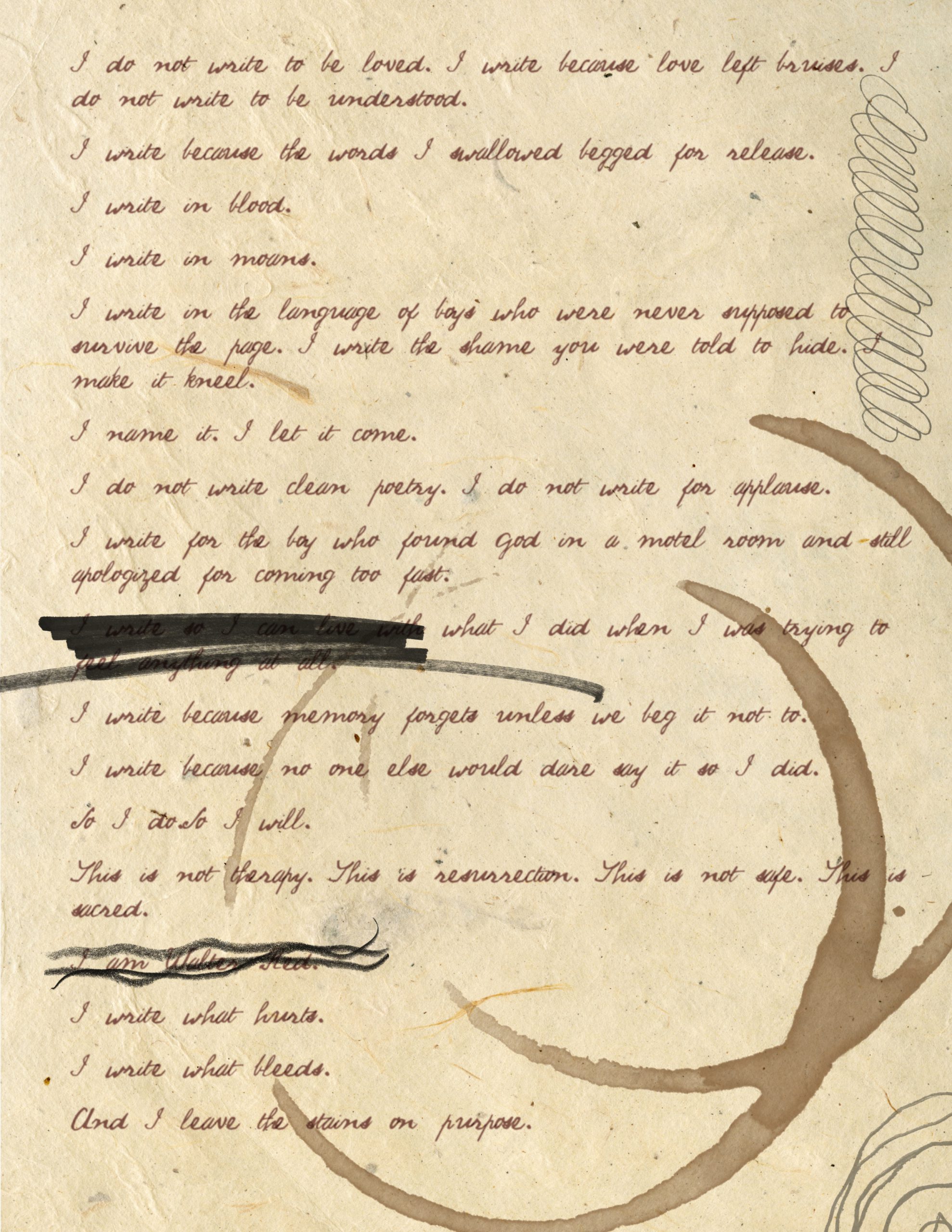
The Stained Glass Window
A Documentary Tryptich
Three connected essays examine a relationship through care, rupture, and repeated attempts at repair. Drawing on preserved correspondence, recollection, creative writing, and witness accounts, the collection follows the development of a record—and the changing questions asked of it. The essays can be read individually or in sequence. The complete edition brings them together with an author’s note explaining their sources and evidentiary limits.


I. Choking On Pride
II. Betrayal as Relational Rupture
III. The Museum of Failure
The opening essay examines the struggle over acknowledgment and accountability: what happens when an account of hurt meets an explanation that leaves its central questions unresolved.
The second essay develops a framework for examining the relationship’s breaks, the expectations surrounding renewed contact, and the difference between returning and repairing.
The final essay returns to the surviving record, holding concrete care alongside recurring instability, disputed events, and the limits of later testimony. It asks what enough documentation can establish when a shared explanation remains unavailable.

The Stained Glass Window
Read all three essays in The Stained Glass Window: A Documentary Triptych, including the author’s note.
This collection is a personal and documentary account of a relationship and its aftermath. It draws onpreserved correspondence, contemporaneous records, later recollections, creative writing, and third-party accounts. These sources carry different evidentiary weight; the essays distinguish them wherematerial and identify uncertainties that affect the interpretation.
Names and identifying details have been omitted or generalized to preserve privacy. Quotationsrepresent the available source material; a statement’s inclusion establishes that it was made, ratherthan independently confirming everything it asserts. Recollection and interpretation are presented assuch.
The collection describes conduct, sequence, and experienced consequences. It does not claim access toanother person’s private motives or offer a clinical diagnosis. Psychological concepts serve asinterpretive frameworks, not findings about any individual.
The account reflects the materials available at the time of revision. It remains open to correction wherefurther reliable evidence warrants it. Its purpose is to preserve a considered account of what occurred,including the care, the harm, and the limits of what can be known.
© 2026 Walter Red Books / Paper Lantern Press