Where the scent of blossoms conceals the first traces.
Stone guardians on the hill, silent since the first watch.
Ruins that hum in the heat, long after the swarm is gone.
The field’s edge, where the grass grows thin and the air shifts.
The History Of The Cathedral
A gate without hinges.
Lines worn thin; they still point toward the oak.
Lean close: the hum beneath the bark keeps time.
An arc that opens east. One stone remembers a fourth.
The hum finds you when the blossoms lean.
Walls that refuse to keep their shape.
Do Not Return Unchanged
This Yellowfield Field Guide introduces the ritual grounds that lie between Cathedral and Basilica. It gathers recovered notes, glyphs, and witness accounts to help you navigate the field’s landmarks — the Mausoleum Rise, the Witness Tree, and the golden blooms that never fade.
Read the declassified report.
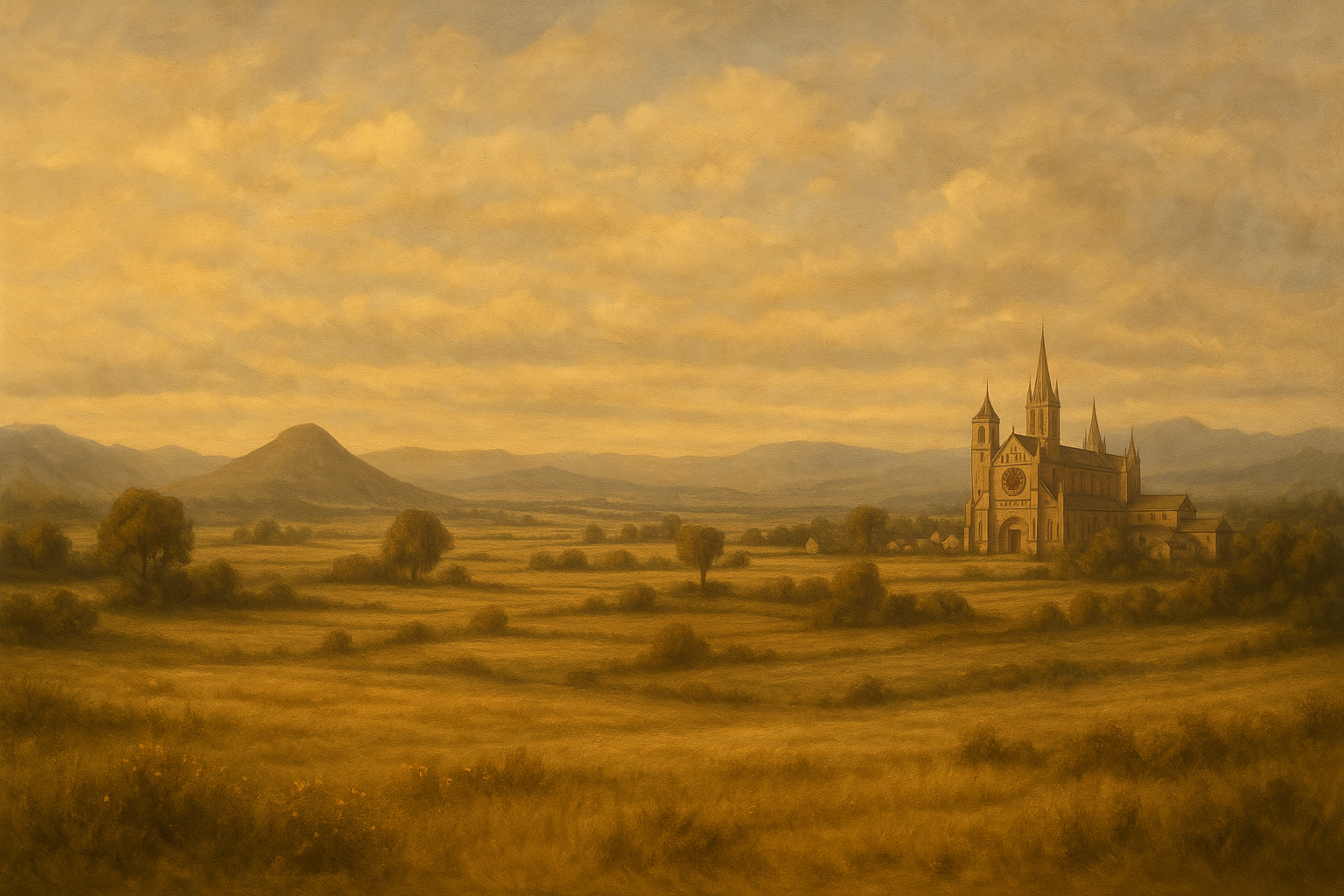
The Yellowfield ritual field stands between Cathedral and Basilica — a threshold of remembrance and light.
Field Survey Guides contain short videos that show the surrounding areas.
The Yellowfield Archive - Declassified: Recovered from field notes, oral testimony, and the private ledgers of the Keepers.
A fringe of wild fruit trees and unkempt hedgerows marks the unofficial border of Yellowfield.
Here, petals fall on packed earth, masking faint sigil impressions and shallow caches.
The orchard’s seasonal bloom is said to disguise entrances to smaller, forgotten paths—some leading back toward the Cathedral, others dissolving into the open plain.
Beneath the blossoms, something always waits. Not hostile, not kind — just waiting.
A sigil pressed into the soil loses meaning until the wind clears the petals away, and then you realize it was never meant for you in the first place.
Perched atop a gradual incline, the Mausoleum is a lone sentinel in stone, weathered by centuries of wind.
Inside, its alcoves hold empty reliquaries and deep-carved names, many struck through or re-chiseled.
Field records suggest its hilltop location was once used as a signal point—fires and lanterns flashing to unseen allies across the valley.
The hill remembers fire. Lanterns once flared here, and I swear sometimes a distant answering flame still flickers back across the valley.
No one speaks of who those signals were for — or whether the watchers ever came down from their post.
This crumbling shell of stone arches and fractured nave has been a point of fascination since the earliest 1973 notes.
On hot afternoons, a low resonance can be felt through the walls, as though a hidden swarm still nests within.
Traces of wax, char, and pollen collect in the cracks, defying any simple explanation.
If you put your hand against the stone at noon, you’ll feel the hum. It is not wind, nor insects, nor echo.
Some call it memory, others an after-swarm. I call it a heartbeat that refuses to die, even when the body is dust.
Beyond the last wildflowers, the ground dips into a shadowed swale locals call the Hollow Verge.
Air currents here are erratic—sometimes warm, sometimes freezing, even in summer.
For those trained to notice, the Verge is less a boundary and more a membrane: step through, and the field behind you may not be the same field at all.
Explorer’s Note:
At the far edge of the field the soil thins, and a hollow gapes open to the dark.
The Verge is less a boundary and more a wound. The land folds downward into a hollow trench, where the grass recedes and bare carth shows through. The sound here is peculiar —
footsteps dull, voices swallowed, even birds fall silent when crossing.
Some call it the field’s “breathing seam.” It divides Yellowfield from the orchard beyond, though not neatly: the roots of both worlds tangle in the soil, locked together like clenched hands
Witnesses report shadows appearing longer than they should bending toward the hollow as though drawn into its silence.
Some say if you kneel close, you will hear a faint rhythm, not unlike a heartbeat – though whether it belongs to the carth or yourself remains unclear.
Erected in the waning years of the Third Winter, the Cathedral of St. Alwyn rose upon the foundations
of a smaller stone chapel lost to fire. The first bell, cast from the salvaged iron of the town’s fallen gates,
rang only seven years before the great collapse of the western tower.
In local memory, St. Alwyn is less a saint of miracle than of burden — a keeper of watch during the long
famine, whose prayers were said to hold back the Hollow. When the famine lifted, the villagers carved
his likeness into the lintel above the nave, face weathered and eyes downcast, so that all who entered
would remember the cost of survival.
Even in ruin, the Cathedral stands as both sanctuary and sepulchre. The stones bear smoke-blackened scars,
and the nave floor is marked with the pale outlines where pews were once bolted. At vespers, when the wind
shifts just right, it is said the echo of that first bell can still be heard, carrying over the fields —
a reminder that some vigils are never truly ended.

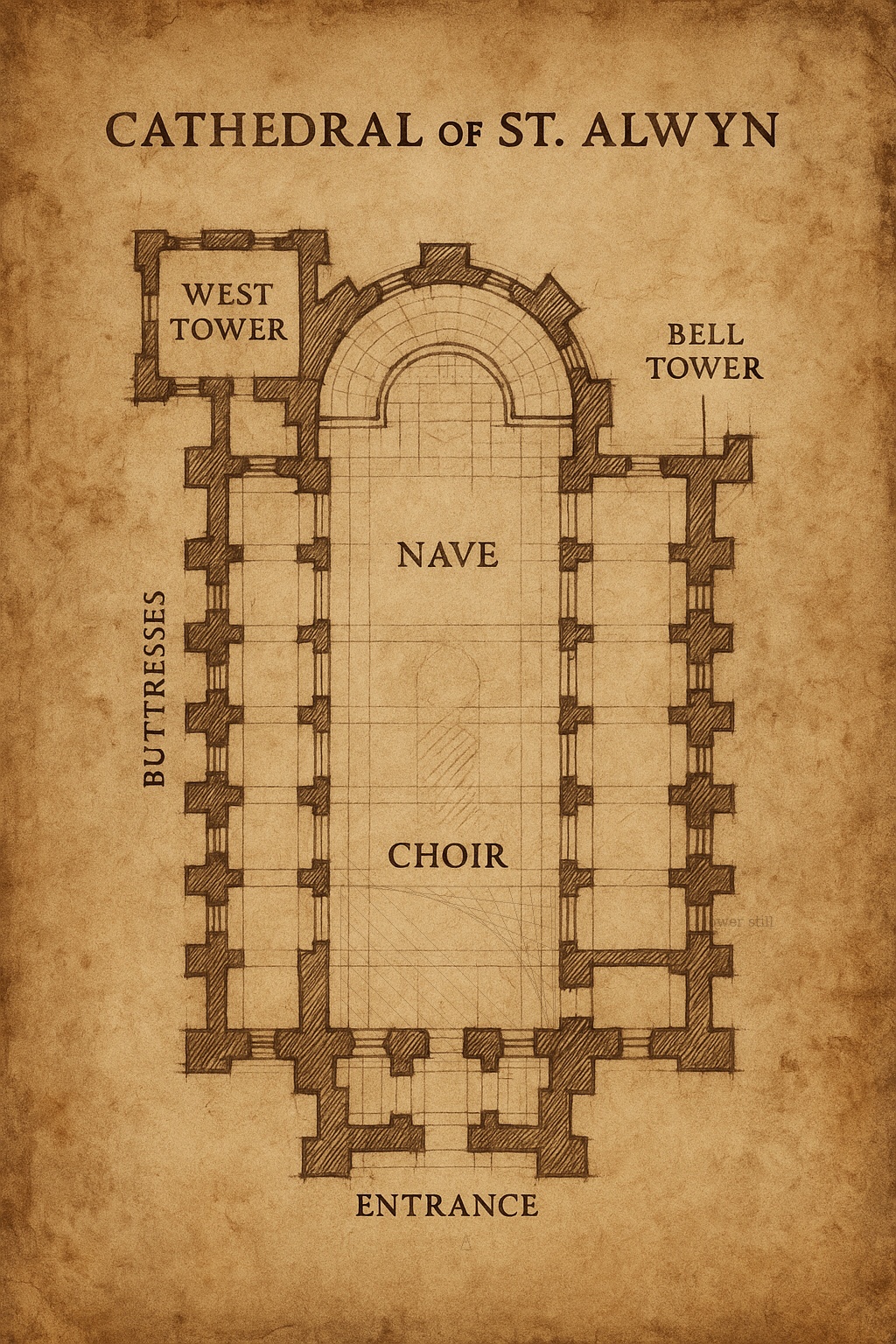
Architectural plan of the Cathedral of St. Alwyn, drafted in the late 18th century. This design reflects the officially recognized structure following the Basilica’s redaction from civic memory. Sections such as the nave, choir, and twin towers are recorded in meticulous symmetry, intended for public distribution and parish records.
YOU HAVE ENTERED A RESTRICTED ACCESS AREA:
PLEASE INPUT YOUR USER CREDENTIALS NOW