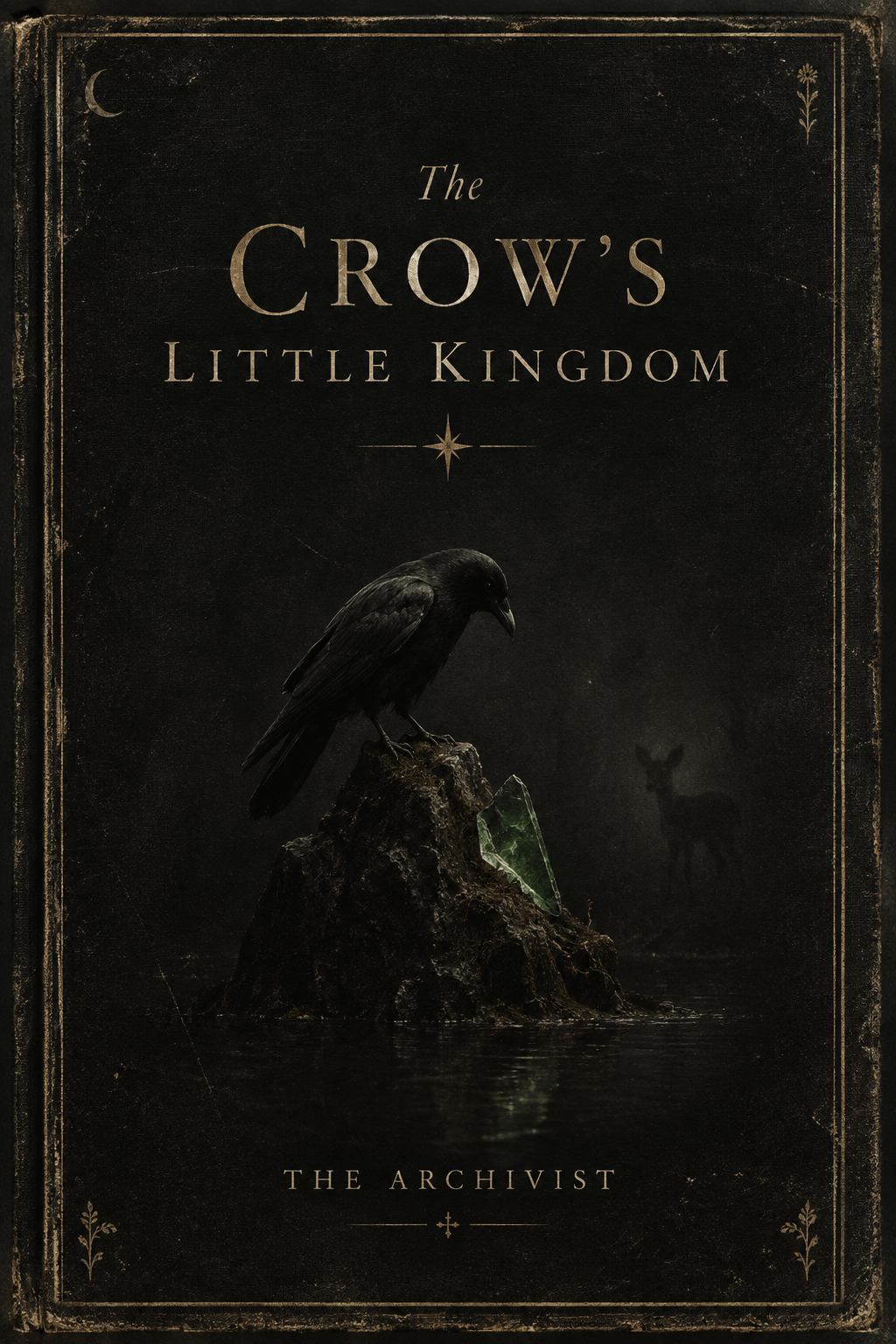
The Crow's Little Kingdom
A Short Story by The Archivist
Paper Lantern Press preserves works of memory, grief, folklore, and the things people leave behind.
Most fairy-tales start with “Once Upon A Time…” this one does not unfortunately. This one begins after the charm has already soured: in a field that keeps old tracks like accusations, beneath a sky the color of tarnished spoons. The grass leaned one way, then another, as if rehearsing departure. In the ditch, a cracked piece of green glass held the morning upside down. Nothing had happened yet, which is often when the ending has already begun.
There was, of course, a crow. There is almost always a crow in stories that distrust the sun. He lived in a storm-split oak whose hollow held last year’s rain and the smell of old lightning, and referred to the arrangement as his kingdom, because loneliness sounds less humiliating when given architecture. The oak had been split clean down its middle, though it continued standing out of habit or spite. Its branches reached like black veins over the field, throwing bars of shadow where nothing had yet learned it was imprisoned. He collected bottle caps, bones, ribbon, anything bright enough to suggest a witness. In the fork of the branches, each object became ceremonial: a crown, a relic, a verdict. He had no subjects, so he practiced sovereignty on the wind.
Every morning he polished his stolen things and waited for the world to recognize the burden of his brilliance. The bottle caps became moons if he tilted them correctly; the bones became pillars; the ribbon became a banner for a country no one had agreed existed. They see me. They do not. They pretend. No—worse—they fail. A field mouse once paused beneath the oak, perhaps to scratch itself, and the crow remembered this for weeks as an audience, then a court, then a procession. Proof, he thought. Or rehearsal. Or envy in miniature. When the world did not applaud, he took the failure personally, though privately he referred to it as evidence of the world’s limitations, then as prophecy, then as persecution arranged tastefully around him.
Then came the fawn: young, spare, and almost transparent with wanting, though not yet wanting him. The fawn moved through the grass with the private concentration of the unharmed, his small hooves parting frost that shone like powdered glass. He lowered his head. He ate. A cobweb clung between two weeds beside him, trembling but unbroken. He did not admire the crow’s black wings, did not flinch at his theatrics, did not look up when the crow announced, to no one in particular, that he had suffered beautifully and therefore deserved reverence.
The crow hated him immediately, though later he would describe this as concern. Not because the fawn had wounded him, but because the fawn had not noticed he was available to be wounded. Indifference, the crow discovered, was a mirror with no reflection in it. He dropped pebbles near the fawn’s hooves, which he called conversation. He laughed when the fawn startled, which he called teaching. He called him simple, soft, earthbound, then decided the fawn had forced him into harshness by being so persistently unformed.
The fawn wandered away, leaving a narrow parting in the grass that closed slowly behind him like water after a stone. The crow watched the green seam repair itself and felt, with theatrical certainty, that the field had chosen a side. This, naturally, escalated matters.
The crow understood, as all small tyrants instinctively do, that direct hunger is unbecoming. So he learned restraint, or what he would later call mercy. He stopped shouting because silence made him appear deeper from a distance. He brought instead a shard of green glass, then a feather, then a song so cracked with counterfeit sorrow it almost became beautiful by accident. There. The head lifts. Recognition. No, surrender. No—arrival. He has been waiting. He has always been waiting. I invented the waiting by withholding myself. The fawn, who had spent much of his short life confusing attention with shelter, mistook the glimmer for a doorway.
“Ah,” said the crow, softly enough to seem transformed. “There you are.”
It is embarrassing, how little warmth a lonely creature needs before he begins calling the weather merciful. The fawn stepped closer. The crow laid the feather at his feet like a treaty, black against the pale grass, a small flag planted in disputed territory. Then he disappeared for three days, which is to say he taught the fawn the first grammar of intermittent love: absence as punctuation, return as reward, silence as a locked room with light leaking beneath the door.
When the crow came back, he carried no explanation. Explanation would have implied equality. Instead he tilted his head and asked why the fawn looked so thin, why he stood in plain sight, why he made need so visible. Let him wonder. Wondering keeps the neck raised. I was never gone. I was above. I was everywhere above. If he suffered, he widened. If he widened, he received me better. The questions entered the fawn like weather through a broken roof. Then the crow touched his beak to the fawn’s ear and spoke gently enough to make the damage feel intimate, as if the wound and the balm had always belonged to the same hand.
After that, the fawn began listening for wings the way some hearts listen for apologies that never arrive clean. The field changed around him. Dew gathered each morning like unsent letters. The oak’s shadow lengthened into a sundial that measured absence more accurately than time. The green glass, when the crow left it near him, threw a false spring across the mud. Some mornings the crow was tender, arranging bright scraps beside him, naming him the only creature refined enough to understand the height of the oak. Other mornings the crow circled above and made a sermon of the fawn’s softness, his need, his stupid faith in landing places, while the feather at the fawn’s ear darkened with rain like a bruise learning to shine.
The fawn, being young and therefore fluent in self-betrayal, mistook inconsistency for mystery. He believed the cruelty proved the tenderness was rare, and the rarity made it precious, and the preciousness justified the waiting. This is how cages learn to call themselves devotion.
But the crow had never loved the fawn. Or perhaps, in the narrow chamber where his heart should have opened outward, he had loved the feeling of being indispensable and called it love because the word was convenient. He loved being reflected in those wide, searching eyes. He loved the proof that he could summon another creature out of peace and into orbit. If he suffers, I am real. No, if he suffers, he understands. No, if he suffers, he is finally useful. Not useful—chosen. Not chosen—mine by weather, mine by witness, mine because he looked up. By dusk he would remember this as compassion. By morning, sacrifice. By the following day, something done to him.
One evening, after rain had turned the field silver and mean, the fawn came to the oak with mud on his legs and a black feather tucked behind one ear. The feather had warped in the weather; its barbs clung together like wet lashes. Around his hooves, puddles held pieces of the crow upside down. “I have carried you everywhere,” he said. “Even when you were gone.”
The crow looked down from his little throne of salvage. Around him, bottle caps and bones rattled like applause from a theater no one had entered. He chose not to notice the wind. The green glass caught the last light and split it into sickly fragments across his breast, making several crows of him, none complete. For one dangerous moment, tenderness stood at the edge of him—not entering, not leaving, only waiting to see whether it would be named. Say nothing. The silence will teach him. No—the silence is a gift. No—the silence is what he asked for by wanting. This is not cruelty. This is restraint. This is architecture. This is how one teaches devotion to stand upright without touching it. Then he smiled, because emptiness, once decorated, can pass for personality.
“You carried a feather,” said the crow. “Not me.”
The sentence was small. That was its genius. It did not need claws. It entered the fawn like winter and clarified everything it froze—or seemed to. He saw, or believed he saw, that every gift had been a hook, every apology a hallway leading back to the same locked room. The crow had accepted devotion as a perch, not a bond. Yet even then, some treacherous part of the fawn wondered whether a perch was the only kind of bond the crow knew how to offer.
The fawn did not curse him. Curses require a kind of hope. He turned from the oak and entered the brambles, where the thorns performed the honest work of showing him wounds he had been calling weather. Seeds caught in his fur like small, patient questions. In the shadows, away from the field’s indifferent witnesses, he began tending to himself—not beautifully, not bravely, and not without listening. Every snap of twig became wings. Every black leaf became a possible return. Healing, he discovered, was not the opposite of longing; sometimes it was longing with its hands kept busy, sorting thorn from skin, blood from rain, echo from voice.
Above him, the crow remained in his little kingdom of sorrow, rearranging his treasures so they might resemble a life. By then he had improved the story. The fawn had not left; he had retreated in awe. No—he had gone to prepare himself. No—he was hiding his gratitude where it could ripen. The silence below was not absence; it was reverence struggling to speak, or punishment, or proof that the fawn had finally learned the majesty of withholding. He polished the green glass until it returned only his own eye, then angled it toward the brambles as if the darkness might admire him from there. He will come back when he understands. He has understood. He cannot return because understanding has made him small. Or sacred. Or cruel. From time to time he called into the field and mistook the echo for admiration, though some nights the echo sounded less like praise than an animal learning not to answer.
And because this was not a fairy-tale, no spell broke, no crown fell, no song arrived to explain the moral. Morning found the oak still standing and the brambles still breathing. Above, the crow sat among his moons of tin and bone, listening for hooves he would later insist he had not been waiting for. Below, the fawn pressed his tongue to a wound and could not tell whether he was closing it or keeping it warm. Between them lay the field, silvering with dew, full of tracks the rain had not yet decided to erase, each print holding the dawn for a moment before letting it go.
Epilogue
Winter came quietly.
The field hardened first, then the brambles, then the shallow places where water had gathered and reflected whatever leaned over them. Snow covered the old tracks until even the earth seemed uncertain who had crossed it and why. The fawn grew.
Not into something fearless. Fear is stubborn, and memory more so. There were still mornings when the beat of wings somewhere beyond the trees tightened something beneath his ribs. Sometimes he stopped. Sometimes he listened. But he no longer looked up every time.
The black feather remained with him for a while. He carried it less as a relic than as one carries a splinter too deep to remove without opening the wound again. Then, one spring morning, he found it caught beneath a thorn bush where it had fallen sometime during the night. He stared at it for a long while. And left it there.
Rain came that afternoon. By evening the feather had sunk into the mud, indistinguishable from bark, shadow, and all the other dark things the forest knew how to return to itself. Far across the field, the storm-split oak still stood. The crow remained among his little treasures, though the ribbon had faded and rust had begun eating through his moons. Some evenings he called into the distance and waited for the sound of hooves.
When none came, he told himself many things.
The fawn was afraid.
The fawn was cruel.
The fawn had forgotten.
The fawn would return.
Years passed. The crow kept his kingdom. The fawn kept walking.
And eventually, somewhere beyond the reach of the oak’s longest shadow, the sound of wings became only the sound of wings.
And because this was not a fairy-tale, no spell broke, no crown fell, no song arrived to explain the moral. Morning found the oak still standing and the brambles still breathing. Above, the crow sat among his moons of tin and bone, listening for hooves he would later insist he had not been waiting for. Below, the fawn pressed his tongue to a wound and could not tell whether he was closing it or keeping it warm. Between them lay the field, silvering with dew, full of tracks the rain had not yet decided to erase, each print holding the dawn for a moment before letting it go.