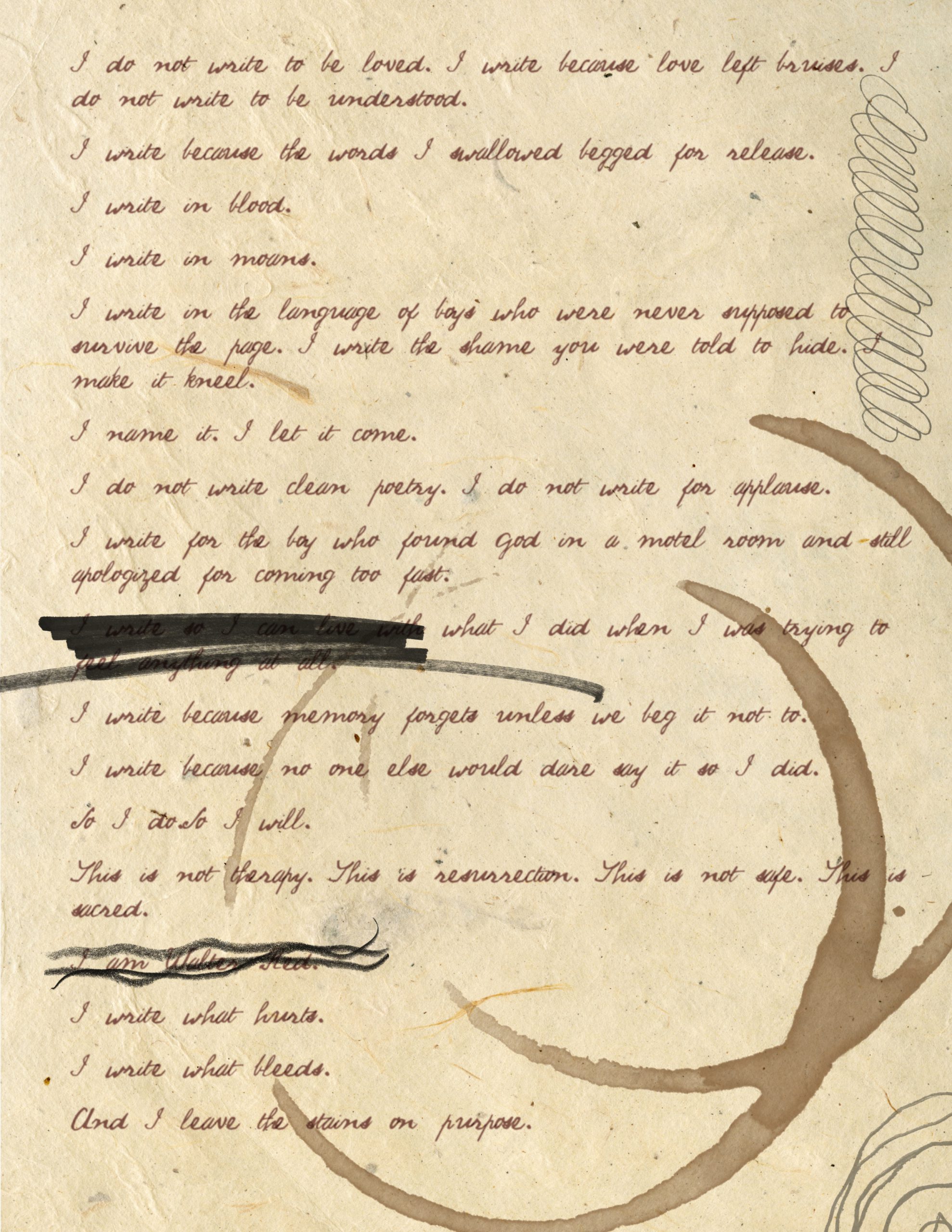
Epilogue: The Man Who Lived in the Shadow
I wish I could tell you that accepting the end of a relationship produces an immediate and lasting sense of peace. It would make for a much shorter book.
Unfortunately, the human mind does not regard a clearly stated ending as sufficient reason to stop searching for an explanation. Especially when the explanation itself has become part of the injury.
June 25 had established that the friendship was over. But it did not resolve the question of what had happened on June 23. Nor did it reconcile the final accusation with the history I remembered.
I had accepted the end. I had not accepted the verdict. And for a while, I continued trying to make that distinction understood.
I wrote letters. Sent explanations. Attempted to correct what I believed had been omitted from the account of the dinner.
I wanted Michael to understand that acknowledging my own poor conduct did not require me to accept sole responsibility for the relationship’s collapse. I wanted him to recognize the difference between an unpleasant emotional reaction and a deliberate attempt to harm someone. And I wanted an answer to a question that had followed me through several cycles of the relationship.
What had he actually wanted?
I could understand a person wanting casual intimacy. I could understand someone deciding that a friendship had become too difficult. I could understand the desire to withdraw from a relationship whose emotional expectations were incompatible with one’s own.
But I had struggled to understand the repeated invitations to rebuild something whose practical terms remained so difficult to establish. I wanted him to explain the discrepancy. He did not.
July arrived. I attempted to return objects associated with the relationship. The signed books. Things I had treasured. Things that had become difficult to keep in my home without remembering the person who had given them to me.
I encountered Michael. He did not want to engage. I remember his expression. I remember the refusal. And I remember how painful it was to see someone who had once welcomed me react so differently to my presence.
I cannot tell you what he was thinking. I cannot establish that his expression meant hatred. But I could see that the encounter was unwanted. And I could feel what that rejection did to me.
There is a particular kind of devastation in discovering that the person whose smile you once anticipated now wants you to leave. I had known intellectually that the friendship was over. That encounter made the separation feel physical.
Not simply a message on a telephone. A person standing in front of me. A face. A refusal. A boundary I could no longer pretend was abstract.
And yet I continued struggling with the unanswered questions. On July 16, I sent another message. I told him that I had heard his verdict but not the charges.
That was how it felt. The moral conclusion had been delivered. The relationship had been terminated. But the specific conduct that justified the most severe characterization remained unclear to me.
I wanted an answer. I did not receive one.
Later, I continued sending material. An attempted clarification. A birthday card. Creative work. A package containing memories, letters, and other things I had made.
I told myself that these were not attempts to reopen the relationship. Some were intended as acknowledgments. Others as corrections. Some as final expressions of affection. And in a narrow sense, I believed that.
But I can recognize something else now. Part of me was still trying to be understood by a person who had already told me that he no longer wanted the relationship.
I wanted the record corrected. I wanted my intentions recognized. I wanted the care I had offered to remain visible. And I was still allowing those wishes to become reasons for approaching a closed door.
The intention was not necessarily malicious. But the impact of repeated contact does not disappear because the person making it feels justified. That is something I have had to confront in my own account.
I was wounded. And I was capable of making the situation more difficult. I was frightened of being misunderstood. And sometimes my attempts to correct that misunderstanding became larger than the relationship could bear.
I was trying to explain myself. But explanation is not always an invitation another person is willing to accept. And eventually, I had to recognize that continuing to offer it would not change the terms of the ending.
Meanwhile, the archive continued growing. The original messages. The letters. The photographs. The gifts.
The essays. The witness accounts. The timelines. The case study. Every fragment seemed to require a place.
I was not satisfied with simply remembering what had happened. I wanted to know when. How. In what order. Who had said what. Which commitments had actually been made. Which ones I had imagined. And which ones remained unresolved because no clear answer had ever been given.
I began treating the history almost as an investigation. Not because I believed the relationship was a criminal proceeding. It wasn’t. But because I had become frightened of losing confidence in my own recollection.
I wanted a record outside my memory. Something I could examine when the emotional intensity of a particular day made everything else difficult to see.
The case study gave me that. It established a chronology. Identified repeated behaviors. Distinguished documented communications from later interpretations. And allowed me to recognize that neither person had been consistently right or consistently wrong.
But it also had limits. A text message can establish that a promise was made. It cannot establish the full emotional meaning of the promise to the person who made it.
A screenshot can show that a meeting was canceled. It cannot reveal every circumstance that influenced the decision.
A witness can describe what they observed. They cannot provide direct access to another person’s thoughts. And a psychological framework can help explain a pattern without becoming a diagnosis of the people involved.
I had to learn to recognize those limits. Otherwise, the archive risked becoming another version of the very problem it was supposed to solve. A structure in which my interpretation acquired more authority than the evidence could support.
I did not want that. I wanted something honest. Even when honesty required correcting my own conclusions. Especially then.
The writing developed its own language. Choking on Pride attempted to examine the entire relationship through the problem of accountability. Not simply whether anyone had cared. But whether the care had been accompanied by the consistency necessary to sustain the connection.
Fifteen Minutes to Lose Everything examined the extraordinary disproportion between the duration of the final dinner and the consequences assigned to it. The event itself had been brief. The history beneath it had not.
That was the distinction. The final evening did not contain the whole relationship. It revealed how much unresolved history could suddenly become relevant inside a single room.
Then came The Homestretch Apology. A different kind of document. Not another argument about who was responsible. An attempt to acknowledge the things I had done poorly.
The emotional intensity. The urgency. The messages written from distress. The occasions when my desire to be understood had become too forceful. The ways I had attempted to make another person recognize the full significance of experiences that might never have carried the same meaning for him.
It was an apology that did not require me to pretend I had never been hurt. And that distinction mattered.
I could regret the manner in which I expressed pain without denying that pain existed. I could acknowledge that my actions affected Michael without accepting his account of every event. And I could recognize that an apology did not obligate him to forgive me. Or respond. Or reopen the relationship.
Finally, If I Had the Words After Loss confronted the possibility that there would never be a satisfactory conversation. That no particular arrangement of sentences could force understanding. That the right explanation might exist and still never be received.
For someone who had spent much of his life believing that sufficiently careful communication could resolve almost anything, this was an extraordinarily difficult conclusion. Because I had always believed in the power of words. I built my life around them.
I wrote books. Poems. Letters. Entire imaginary worlds.
I had always regarded language as a bridge between people. And now I was confronting the possibility that a bridge could be beautifully constructed and still lead to a place where nobody intended to meet me.
The creative work continued expanding. The documentary materials became part of a larger three-part account. The case study became a separate analytical instrument. The poetry developed into additional literary pieces. The video projects introduced another medium through which memory could be represented.
There was music. An entire rock opera. A substantial musical reimagining of a book. The stories began acquiring voices, imagery, melodies, and structures that no written chronology could provide on its own.
It was an astonishing amount of material to emerge from one period of my life. Sometimes I looked at the collection and wondered what a person would think if they encountered it without knowing the circumstances that produced it.
A three-part documentary. A multi-chapter memoir. A private case study.
Letters. Poems. Films. Albums. Dozens of pieces of music. All surrounding a relationship that, to the outside world, might have appeared to be little more than an unusually complicated friendship.
I could understand someone finding that overwhelming. I could understand Michael wanting distance from material in which he occupied such a central place. I could even understand why being the subject of another person’s extensive creative and analytical work might feel uncomfortable rather than flattering.
There is a difference between inspiring an artist and consenting to become the permanent subject of his archive. I had to recognize that.
Because the work belonged to me. But the person who inspired much of it did not.
That was the boundary I had struggled to understand. The difference between remembering someone and retaining a claim upon them. Between documenting the past and continuing to seek an audience from the person who had left it. Between creating a work of art and making the person it depicts responsible for what the work means.
I had made extraordinary things. But Michael was not obligated to admire them. Nor was he obligated to accept them as evidence that the relationship should have continued.
The work had to become capable of existing without his participation. Otherwise, it was not truly finished.
And then there was the building. The almost offensively literal detail that no novelist in possession of a functioning editorial department would have dared invent. I could still see where Michael lived.
The physical geography of our lives had not reorganized itself simply because the friendship ended. He remained somewhere within the ordinary landscape of my days.
A building. A window. A familiar direction. A place I had once approached with excitement. A place I had eventually left in tears.
It was possible to stop sending messages. Possible to stop visiting. Possible to stop asking questions. But I could not reasonably expect the city to remove the building as an accommodation to my grief. Seattle, with its customary emotional sensitivity, had declined to participate in the healing process.
And so I had to learn something considerably more difficult. How to live near the place without continuing to live inside the memory. How to look at the skyline without turning every window into a question. How to allow a building to become a building again.
I was not there yet. Perhaps I would not be for some time.
But I understood that this was now part of the work. Not the literary work. Not the documentary. Not the psychological case study. The ordinary, unglamorous work of continuing to live.
October 25 was approaching. Three years since the first meeting. Three years since I had arrived downtown and introduced myself to a stranger whose presence would eventually alter the course of my life.
I remembered that afternoon. The anticipation. The excitement. The extraordinary innocence of believing that something intended to happen just once could remain confined to the moment in which it occurred.
I remembered everything that followed. The infidelity. The confession. The forgiveness I had not expected. The boundaries. The birthdays.
The departures. The returns. The hospital rooms. The cabin. The poem. The framed photograph of a memory. The unfinished stained-glass window.
The books. The gifts. The dinners. The unanswered questions. And finally, the room in which the friendship ended.
I could no longer look at the history and pretend it had been simple. Nor could I reduce it to a story about one cruel person and one innocent victim.
I had entered the relationship dishonestly. I had experienced genuine affection. I had hurt Charles. I had been shown kindness.
I had behaved badly during moments of distress. I had encountered inconsistency and rejection. I had made things that mattered to me. And I had struggled for months to accept an ending that did not contain the explanation I wanted.
All of those things belonged to the story. None could be removed without changing what happened.
And perhaps that was the final lesson. Not that I had learned everything about Michael. I hadn’t.
There were things I would never know. There were memories he possessed that I had never witnessed. Experiences he understood differently. Feelings he never expressed. And perhaps an entire account of our relationship that would sound astonishingly unlike my own.
I could not complete that account for him. I could only complete mine.
For a long time, I believed that the purpose of the archive was to arrive at a final answer. A perfect explanation. Something so thoroughly documented, so carefully reasoned, and so resistant to contradiction that it would become impossible for anyone to misunderstand what had happened.
I no longer believe that. The archive cannot compel recognition. It cannot produce an apology. It cannot create mutual understanding where one person no longer wishes to participate. And
it cannot transform the past into something less painful simply because every date has been placed in its proper position.
But it can preserve a history. It can distinguish fact from interpretation. It can acknowledge affection without denying injury. And it can permit me to stop treating unanswered questions as obligations that must be fulfilled before I am allowed to move forward.
That is what I want this work to become. Not a summons. Not a monument to resentment. Not an elaborate attempt to persuade Michael to return.
A record. A testimony. And, perhaps, an ending.
The relationship has ended. The correspondence no longer needs to continue.
The books have been written. The poems have been preserved. The case study can remain private. The music can belong to the people who hear themselves within it. And the documentary can tell the story without requiring its subject to approve of the telling.
As for Michael, I hope the happiness I once wished for him eventually finds him.
I do not know what he thinks of me now. I do not know whether he remembers the poem. Whether he kept the books. Whether he ever looks at the artwork. Or whether the little coffee plant is still alive.
Those questions once seemed unbearably important. Perhaps some part of me will always wonder. But I no longer need to answer them to understand what those objects meant when I gave them.
The care was real. The memories were real. The harm was real. And the ending is real. I can preserve all four truths without asking anyone else to reconcile them for me.
There will be another October 25. And another. The city will continue changing. The buildings will remain until someone decides to replace them.
Charles and I will continue living the life that exists outside these pages. I will keep writing, and the books will continue finding readers beyond the history that helped create them.
The little cathedral of memory will continue standing wherever I choose to place it. And somewhere within its stained-glass windows, there will always be a quiet image of two men sitting beside a lantern-lit table in the mountains.
I do not need to break that window simply because the friendship ended. I do not need to stand outside it forever, either.
I can leave the memory where it belongs. In the past. Beautiful. Imperfect. Finished.
The man in the window was someone I loved. The man who walks away from it is someone I must learn to care for, too.
And that, finally, is where the story ends. Not with a verdict. Not with another letter. Not with a request for one last conversation. But with a life that continues after the person who inspired so much of its art has left the room.