Chapter Five: The Making of Walter Red
There is a peculiar misconception about grief that I have never particularly understood. People imagine it as an interruption. Something arrives, devastates your world, and eventually departs, allowing the machinery of ordinary life to resume.
A wonderfully convenient theory. Unfortunately, ordinary life has never demonstrated much willingness to wait for anyone.
The bills continue arriving. People get married. People get sick. Someone needs groceries. Someone else needs a ride. Your employer still expects you to appear at an appointed hour, perform your duties, and preferably refrain from experiencing a complete psychological collapse during business operations. And somewhere amid this extraordinary collection of inconveniences, you’re supposed to find time to recover from losing someone you love.
March 31, 2025, had been another goodbye. The third. And this time, Michael had made himself clear. We were not going to continue seeing one another. Not romantically. Not physically. Not even as friends.
I understood what he had written. Understanding it, however, proved rather different from knowing how to live with it.
I remember the sadness. The exhaustion. The peculiar humiliation of having once again become overwhelmed by a relationship whose limitations I had known from the beginning.
I remembered his kindness. The cabin. The hospital. The poem. I remembered the person who had sat beside me while Charles underwent a cardiac procedure only thirteen days before ending our friendship. And I struggled to understand how those memories were supposed to occupy the same emotional space as his goodbye.
But I could not spend the rest of my life examining March 31. There were other things happening. Many other things. And they were not particularly interested in waiting until I had recovered.
Charles and I were still navigating an exhausting succession of medical concerns. Surgeries. Procedures. Appointments. Recoveries. The endless practical arrangements that accompany a long period of uncertain health.
There are only so many times one can become familiar with a hospital before the entire medical establishment begins feeling like an especially unpleasant extension of one’s social calendar.
But alongside those difficulties, there were celebrations. Weddings. Family gatherings. Holidays. Visits. Little journeys away from Seattle. All the ordinary rituals through which people maintain their connections to one another.
Charles’s family remained part of our lives, and those gatherings were a reminder that the world contained relationships considerably older and more established than the one I had just lost. There were moments of laughter. Moments of comfort. The peculiar joy of attending someone else’s wedding and briefly allowing yourself to believe that human beings might, against all available evidence, be capable of making lasting promises.
It would be dishonest to describe that period as nothing but misery. There was happiness. Real happiness. And Charles was part of it.
He was also the person who had already experienced the consequences of my decisions at the beginning of this story. That fact did not disappear simply because my involvement with Michael had ended. If anything, the separation forced me to confront how much of my emotional attention had become occupied by someone outside the relationship in which I had spent nearly all my adult life.
I had responsibilities at home. I had promises of my own. And I had a person beside me who deserved considerably more than the exhausted remnants of whatever emotional energy I had left after grieving someone else.
That realization was uncomfortable. Necessary, perhaps. But uncomfortable. I had spent so much time trying to understand why Michael could not meet my needs that I was beginning to recognize how frequently I had neglected to examine what Charles might need from me.
That did not make the two relationships interchangeable. They weren’t. Nor did it mean that loving one person invalidated the significance of another. But I could not continue pretending that my grief existed without consequences for the people living alongside it. And Charles had already carried enough.
Then my professional life began collapsing. I had spent years working in an environment that had become increasingly draining. The accumulated frustrations, institutional complications, and ordinary exhaustion of employment had already been wearing me down.
Then came an investigation. Serious allegations were raised against me. I disputed them. The process became frightening, exhausting, and increasingly difficult to navigate. I was asked to participate in a formal interview without feeling that I had received enough information to understand precisely what I was expected to answer.
I could have continued contesting the matter. But by then, I was exhausted. Emotionally. Professionally. Financially. And I no longer believed I had the resources or desire to endure what I feared might become a prolonged dispute.
So I resigned. I left. Not triumphantly. Not with the magnificent satisfaction of delivering some extraordinary resignation speech while an orchestra performed in the background. I simply reached a point where continuing seemed less survivable than walking away.
There was grief in that decision, too. A different kind. The loss of professional identity. The loss of routine. The loss of the structure around which so much of my daily life had been organized. And the uncertainty of what I was supposed to do next.
Then, almost immediately afterward, someone attempted to blackmail me. Because apparently the universe had reviewed the existing situation and determined that it lacked sufficient administrative complications.
I will not turn that experience into another person’s identifiable story here. The details belong in their appropriate record. But the effect on me was substantial. I felt cornered. Angry. Frightened. And increasingly exhausted by the expectation that I should somehow remain composed while multiple areas of my life appeared to be collapsing simultaneously.
I had lost Michael. I had left my job. I was dealing with an attempted coercion. And the familiar medical and domestic responsibilities of my life had not magically ceased.
There was no grand period of recuperation. No restorative retreat. No charming little interval in which I could sit beside a window, contemplate my circumstances, and emerge several weeks later with an improved personality and a tastefully understated understanding of the human condition.
There was simply the next day. And then the next. And I had to find something to do with them.
I began writing more intensely. Not because I had developed some extraordinary plan to transform my suffering into a publishing empire. That came later. At first, I wrote because the alternative was allowing everything to remain an indistinguishable mass of grief, anger, shame, and unfinished thought.
Writing gave those experiences edges. A beginning. A progression. An ending. Even when my life seemed stubbornly determined to provide none of those things.
I returned to older manuscripts. Revisited ideas. Reconsidered projects that had remained unfinished. And slowly, an ambitious undertaking began taking shape.
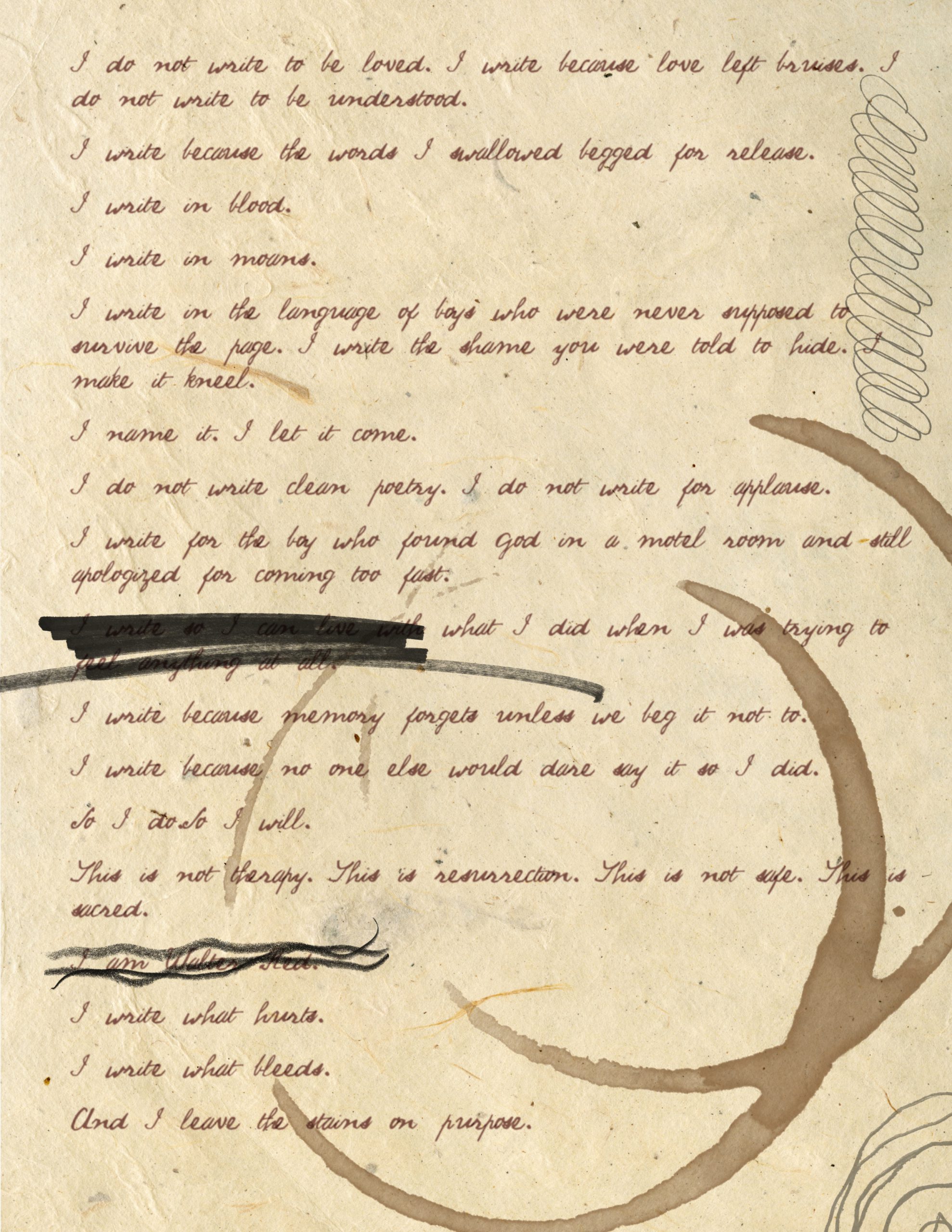
Walter Red. The name had existed before this period. It was familiar to me. A literary identity. A voice through which I could explore things that were difficult to approach directly.
But I had begun using it for something more complicated. Walter Red could say things that Jared found difficult to admit.
Walter Red could be theatrical. Cruel. Devotional. Absurd. Tender. He could build cathedrals from grief and populate them with ghosts without requiring anyone to ask why the architect had spent so much time studying the dead.
It was an extraordinarily convenient arrangement. A man could place his most uncomfortable emotions into literature, give the resulting figure a different name, and claim the entire experience was a creative exercise. A wonderful little piece of psychological bookkeeping.
The trouble was that the books were mine. The memories were mine. The grief was mine. And eventually, I began realizing that the distinction between myself and the person writing them had become less clear than I wanted to believe.
I had been constructing a refuge. But somewhere along the way, the refuge had begun resembling a second identity. And I was no longer entirely certain which of us was supposed to be living the life outside the pages.
I did seek help. I began therapy. For a period, I had access to someone who offered me room to examine the experiences that had been accumulating beneath my more recent difficulties. The relationship with Michael was part of that. But it was not the whole of it.
There were older wounds. Older fears. Things that had shaped how I responded to rejection, uncertainty, confrontation, and intimacy long before October 2023.
I had developed habits of survival that had once been useful. The problem with survival habits is that they rarely receive notification when the original emergency has ended. They simply continue operating. Sometimes for years. Sometimes long after the circumstances that created them have disappeared.
I began recognizing how certain reactions had become almost automatic. The urgency. The need for an answer. The fear that silence meant something terrible. The way I could begin constructing elaborate explanations for events before anyone had provided sufficient information to justify them.
I was learning. Not always gracefully. But learning.
At one point, I spoke with my mother about something I had carried for more than twenty years. It was a deeply difficult conversation. I cried. I told her things I had struggled to articulate for much of my life.
And afterward, I felt as though some terrible weight had shifted. Not disappeared. Not magically dissolved. But shifted enough to let me understand that I had been carrying it.
There is something profoundly strange about realizing that an old wound has influenced so much of your life while remaining almost invisible to you. You begin reconsidering memories. Reactions. Relationships. And the person you believed yourself to be.
I did not emerge from that period cured of every difficulty. That would have been remarkably convenient. But something important had begun changing.
I was no longer exclusively interested in explaining why other people hurt me. I was beginning to ask why certain experiences had such extraordinary power over me. And what responsibility I had for the ways I responded.
June arrived. My birthday. Thirty-six. A perfectly respectable age at which to begin discovering that one’s emotional operating system contains several undocumented features and at least one catastrophic design flaw.
Charles and I traveled to Portland to celebrate. We stayed with a close friend. I reconnected with people who had been important to me long before Michael entered the picture, including someone who had once been my first great love.
Charles and that old friend got along well. I remember enjoying that. There is a particular comfort in discovering that people from different periods of your life can occupy the same room without anyone needing to conduct an emergency diplomatic summit.
It was a good trip. A reminder that my life had contained meaningful relationships before Michael and would continue containing them afterward.
I was capable of happiness. I was capable of connection. I was capable of participating in the world without spending every waking moment wondering whether someone who had left it might return.
And when we came home, I received news that would become one of the defining moments of my creative life. June 18, 2025. Walter Red Books LLC had been certified by the State of Washington.
It was official. My publishing imprint existed. Not simply as an idea. Not as a folder on my computer filled with increasingly elaborate plans. As a legal business. My business.
I remember the excitement. The disbelief. The peculiar satisfaction of watching something that had existed in my imagination take on an independent, tangible form.
For the first time in what felt like an extraordinarily long period, I had built something that could continue growing regardless of whether a particular person wanted to remain in my life. It was mine to maintain. Mine to develop. Mine to shape.
There were books to finish. Covers to design. Production details to solve. Publishing arrangements to understand. And an increasingly elaborate universe of symbols, settings, and characters demanding my attention.
I had created an extraordinary amount of work for myself. Naturally. Apparently, when presented with an opportunity to simplify my life, I preferred to establish a publishing house and populate it with an entire theological bureaucracy.
But I loved it. I was building. And that felt considerably better than waiting.
The books became more than manuscripts. They became a way of examining the person who had written them. Daddyland, in particular, took me somewhere I had not anticipated. I had begun working within a familiar literary identity and eventually found myself confronting aspects of my own experience that I had hidden behind that identity.
The material became darker. More personal. And increasingly difficult to regard as something entirely separate from me.
I remember reaching a point when I was disturbed by the direction my own imagination had taken. There were ideas I did not want to pursue. Material I did not want to release. Things that seemed to belong more appropriately in a private archive than in a book intended for readers.
And for once, I stopped. I reconsidered. I recognized that the ability to create something did not automatically mean I ought to publish it. That distinction became important.
There is power in writing. Particularly when the subject is connected to experiences that have wounded you. You can construct entire worlds in which the person who hurt you is finally made to understand.
You can write their confession. Their punishment. Their redemption. Their destruction. You can give every unanswered question a reply. Every unresolved conflict a verdict. You can create the ending reality refused to provide.
But that power carries responsibility. And I began recognizing that my work could not simply become an instrument for doing whatever my most wounded impulses desired.
Some things belonged in the archive. Some things needed to remain sealed. Others could be transformed into literature without preserving their original, more destructive intentions.
I chose to continue creating. But I also began making decisions about what creation was for.
That was part of what I later called my liminal rupture. A period in which the boundaries between the identities I had constructed and the person living behind them became painfully difficult to maintain. I was no longer satisfied with hiding inside the character of Walter Red. I wanted to understand what he represented. And why I had needed him.
It was uncomfortable work. But the result was not simply another book. It was a recognition.
I was responsible for what I created. And I could no longer pretend otherwise.
There was, however, a promise I had made before the final goodbye in March. A dedication. I had told Michael that I intended to acknowledge him in one of my books. At the time, it had seemed like an ordinary expression of gratitude. An acknowledgment of someone whose presence had helped inspire me.
The relationship was over now. But the promise remained.
I considered it. I could remove his name. Pretend the inspiration had never existed. Rewrite the history until the finished book appeared to have emerged untouched by the experiences that had helped shape it. But that would have been dishonest.
Whatever happened between us, Michael had mattered. He had shaped memories, encouraged work, and inspired art—but the work was still mine, and its meaning did not vanish when the friendship ended. He had encouraged me. Shared his own creative life with me. Offered practical insight into things I was trying to understand. And inspired work that I might never have written in precisely the same way without knowing him.
Those were facts about my experience. The ending did not erase them.
So I kept the dedication. Not as an invitation. Not as a request for reconciliation. But because I had promised. And because I wanted the work to preserve the truth of what had inspired it, even if the relationship itself could no longer continue.
There were other things I had prepared, too. Letters. Artwork. Poems. Little offerings created during a time when I was still trying to understand how to live with the absence.
For the most part, I kept them. I did not send them. I had been told the relationship was over. I intended to respect that.
If Michael ever returned of his own accord, perhaps there would be an opportunity to share some of those things. If not, they could remain in my archive. They had served a purpose simply by being made.
I did not yet fully understand that distinction. But I was learning it.
An artwork could be meaningful without being received by its subject. A letter could help me organize my thoughts without becoming another message demanding someone’s attention. A poem could preserve affection without requiring the person who inspired it to do anything in return.
Those were important lessons. And during those months, they allowed me to keep creating.
Summer passed. Then autumn. The publishing work continued. The books developed. The little literary universe expanded into something increasingly elaborate.
The cathedral. The garden. The relics. The strange symbolic geography through which I had begun mapping the experiences of my life.
I was creating places for things I did not know how to leave behind. Some memories became rooms. Others became flowers. Some became characters. And some became objects placed carefully inside imagined buildings, where they could remain without occupying every available space in my actual home.
I was building an architecture of memory. Not because I believed memory could resurrect the past. But because it could preserve the parts of the past I still wanted to understand.
Charles remained part of the life surrounding that work. Our home. Our celebrations. Our continuing responsibilities. The ordinary and extraordinary difficulties of keeping a relationship alive while both people carried the consequences of what had happened.
There were moments of closeness. Moments of exhaustion. Days in which the practical demands of life left little room for grand emotional reflection. And I was still working to become someone who could participate in those moments more fully.
I missed Michael. Constantly, of course. There were memories that remained tender. The cabin. His smile. The way he had looked when I read him the poem.
But the grief was no longer the only thing happening in my life. I had begun developing something independent of him. An identity. A vocation. A world. And while I could not honestly say that the loss had become painless, I had reached a point where I no longer believed my future depended on whether he would return.
Then October ended. November began. And at 3:22 in the morning, November 2, 2025, the past knocked on the door again. This time, however, the person answering was not quite the same person who had watched it close in March.