There are apologies that attempt to repair a relationship. There are others that exist because repair is no longer the available category. This belongs to the second kind. Its purpose is not to reopen the door, resurrect the conversation, or persuade the other party into recognition. Its purpose is quieter: to distinguish remorse from appeal, tenderness from permission, and memory from access.
The record matters because the loss was not simply emotional. It was structural. The injury did not arise from one failed evening, one misread invitation, one difficult exchange, or one painful fifteen-minute sequence. The injury arose from a recurring pattern in which warmth appeared often enough to preserve attachment, but not consistently enough to create safety.
That distinction is the hinge. A relationship can contain care and still fail at containment. A person can be tender and still unreliable. A bond can be real and still become unsafe to continue. The common error after this kind of loss is to ask whether it mattered. The better question is whether what mattered was organized into a structure capable of carrying consequence. In this case, the answer was no.
The Apology as Record
The apology begins with a simple admission: I was not the person first encountered. That is not melodrama. It is consequence. Ambiguity changes people. Intermittent access changes people. Repeatedly attempting to convert warmth into reliability changes people. The earlier self could treat tenderness as weather. The later self had been trained by the pattern to read weather as survival data.
This is where responsibility becomes complicated but not impossible. I am sorry for the ways longing was allowed to impersonate a plan. Wanting is not architecture. Desire is not a logistical framework. Emotional truth does not become a viable structure merely because it is intense. That error belonged to me. I treated possibility as evidence and sometimes treated evidence as destiny, because grief and hope can make almost anything feel like a sign.
I am sorry for the grief I carried badly. There were moments when fear arrived before judgment, when injury became accusation, when panic put on the costume of analysis and called itself clarity. That does not erase the pattern. It does not make the breach imaginary. It simply prevents the easier lie that harm only moved in one direction. The more accurate sentence is harder: I was wounded, and I was capable of wounding.
I am sorry we were never meant to become what I kept trying to make possible. The sentence is brutal because it does not cancel what was real. In fact, it hurts because enough was real to make the failure consequential. The warmth was real. The care was real. The attachment was real. The problem was not falseness. The problem was ungoverned reality: feeling without structure, access without accountability, memory without a durable future.
I am sorry for the lies I told, including the internal ones. Chief among them was the belief that potential could serve as a contract. Potential is seductive because it asks for very little in the present while borrowing enormous credibility from the future. It says: not yet, but maybe. It says: the best moments prove the whole structure. They do not. A person’s best moments are data. They are not a binding agreement. Sometimes the data says only this: he could, but he did not.
I am sorry for the worry my collapse produced. The body does not always wait for language to organize what has happened. It learns delay, tone shift, omission, cancellation, and withdrawal as a sequence. It begins predicting loss before the mind has assembled the evidence. The nervous system becomes an unwilling witness to patterns the heart still wants to soften.
I am sorry for the nearly three years spent inside a connection that repeatedly became more than it was willing to name, then less than it had implied it might become. This was the central instability: closeness without continuity, tenderness without dependable form, future language without future labor. No one needs malicious intent to create that kind of pain. Sometimes avoidance, ambiguity, stress, affection, and hope are enough.
The Objects as Closure Instruments
The returned objects matter because they perform a function language could no longer perform. Books, sketches, inscriptions, gifts, and symbolic remnants are not neutral once a relational structure collapses. They become portable rooms. They preserve the atmosphere of a prior arrangement and ask the injured person to keep housing it. That can be tender when the bond remains safe. After loss, it can become too heavy to hold.
Returning them was therefore not revenge. It was a boundary made visible. It said: these items belong to a version of the relationship that no longer has residency here. Keeping them would have preserved implied access for a structure that had ended. Returning them helped separate memory from permission, which is one of the first requirements of closure.
The Fifteen-Minute Disclosure
The fifteen-minute event matters not because it contains the whole relationship, but because it revealed the operating system. Sometimes an ending does not need much time. It needs only the right conditions: an invitation framed one way, a room arranged another way, material information withheld until arrival, and the injured party left to process the change in real time.
The breach was not the existence of another person in the room. The breach was the undisclosed change in terms. The invited person was denied the dignity of informed choice and then left to carry the consequences of reacting to what had not been disclosed. In that moment, the omission became the center of the event, even if no one intended for it to cause harm.
That is why the number matters. Fifteen minutes is not the story. It is the timestamp on the disclosure. It proves how quickly years of relational ambiguity can become legible once the pattern stages itself plainly enough. The dinner never happened. The verdict did.
What Remains Refused
What remains refused is the old assignment of blame. I am not sorry for needing structure. I am not sorry for wanting directness. I am not sorry for asking not to be surprised by the terms of a room and then left alone with my reaction once the terms were revealed. The request was not excessive. It was a request for basic clarity.
I am not sorry for refusing to call instability patience, omission courtesy, or silence care. Those substitutions can happen easily in avoidant systems because they protect everyone from the harder work of naming what is occurring. One person keeps flexibility; the other absorbs instability. Over time, that imbalance begins to show in the body, the memory, and the relationship itself.
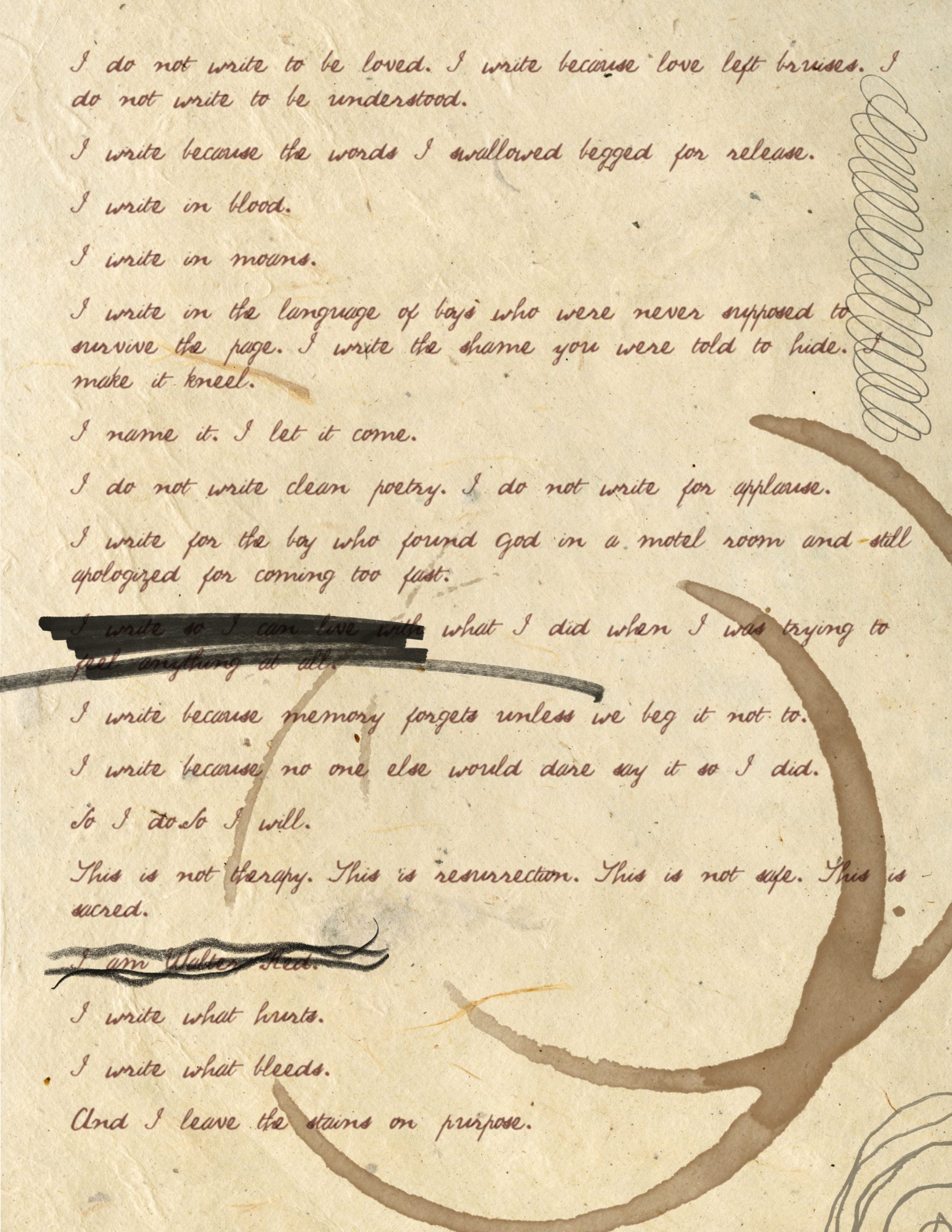
The archive was not built as revenge. It was built because ambiguity corrodes memory. Screenshots, timelines, letters, essays, returns, and closure instruments exist because the injured person eventually needs a record outside the fog. The file answers the question the nervous system keeps asking in the dark: did this happen? Yes. This happened. This was the sequence.
The Aftermath as Evidence
The aftermath is evidence because the body keeps the ledger after the conversation ends. It is not clean. It is not elegant. It is the reflexive scan for messages that will not come, the old preparation for rescue or ruin, the apartment reorganized around the absence of objects that had become too loud to keep. Loss did not make the room smaller. It made the room honest.
Aftermath is repetition without the other person. The mind continues running a program after the system it was designed for has been removed. It wakes, checks, remembers, argues, rehearses, and reopens. It attempts to solve a problem that has already given its final answer.
Eventually, if the record holds, the aftermath becomes survivable. Not redeemed. Not made beautiful for anyone else’s comfort. Survivable. The body stops treating every silence as weather to interpret. The archive stops functioning as an emergency flare and becomes a closed file. The loss remains, but it no longer has the same authority.
The File Closes
The final act is not forgiveness, though it may look calmer than anger. It is separation. It separates tenderness from access, apology from appeal, and memory from permission. It allows the statement to remain intact without becoming an invitation: I was harmed, and I loved. I was dismissed, and I mattered. I was there. He was there. It mattered.
That separation is the closure available when mutual recognition does not arrive. The injured person does not need the other party to validate the pattern for the pattern to have existed. He does not need confession to establish breach. He does not need a final conversation in which every sentence finally lands correctly. That wish belongs to the open loop, and the open loop has already asked enough of him.
So, if these are the words, they are not a plea. They are the quiet end of a long emotional proceeding. I am sorry for what I carried badly. I am sorry for what I broke while trying not to break. I am not sorry for finally believing the evidence. I am not sorry for returning the relics, laying down the weapons, and stepping out of the room that could not hold me without asking me to disappear. What remains is not an appeal. It is an archive. The door is not waiting. The file is closed.
After the File
But a closed file is not the same thing as a closed life. That distinction matters too. Closure does not have to mean the heart becomes sealed, suspicious, or permanently arranged around the shape of what hurt it. It can mean the opposite: that the heart is no longer required to keep presenting evidence to be believed. It can rest. It can stop litigating the wound. It can begin, slowly and without ceremony, to belong to itself again.
Hope, after this kind of loss, is not a bright announcement. It is smaller and more durable than that. It is the first morning the silence does not feel like a verdict. It is the first object that remains only an object. It is the body learning that not every delay is danger, not every room is a trap, and not every tenderness must be interrogated before it can be received. It is the quiet return of trust, not necessarily in another person at first, but in one’s own ability to notice, to choose, to leave, and to stay where staying is kind.
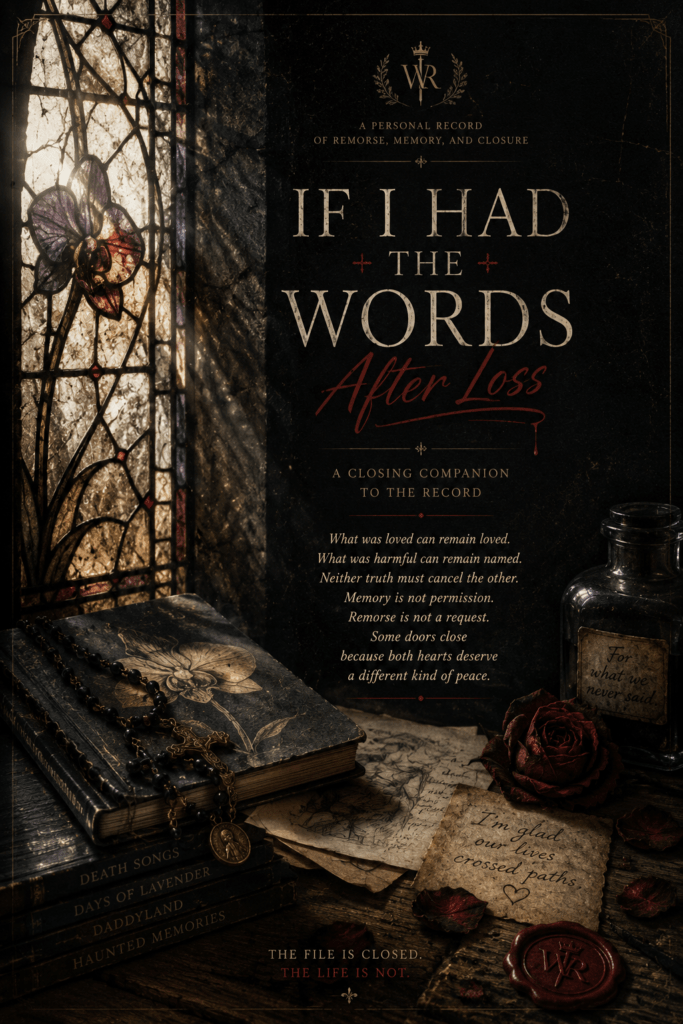
The archive remains, but it no longer must be carried like a weapon or a shield. It can become a shelf. A record. A place where the past is allowed to stay without governing the next room. What was loved can remain loved. What was harmful can remain named. Neither truth must cancel the other, and neither must decide the future alone.
I think of the walk home after the dinner, not because it was noble or cinematic, but because it was ordinary in the most devastating way. The door had closed behind me, and the city kept going. The elevator arrived. The sidewalk was still warm. My shirt was still damp from the heat, the medical emergency before dinner, and the shock of leaving with more answer than conversation. I remember getting back home with my body still braced, carrying the book, the unfinished drawing, the water bottle, the residue of hope, and the sudden knowledge that something had ended before I had found language for it. Nothing in the apartment had changed, but everything had become rearranged around absence.
So, the final hope is not that the story will be rewritten. It is that the person who survived it will keep writing beyond it. The door is not waiting, and that is a mercy. The file is closed, and that is a beginning. There will be other rooms. There will be clearer invitations. There will be forms of care that do not require translation into safety. There will be a life large enough to hold the evidence, the grief, the tenderness, and still make room for something gentler to arrive.